Fire Door Remedial Works: A Guide for Managers
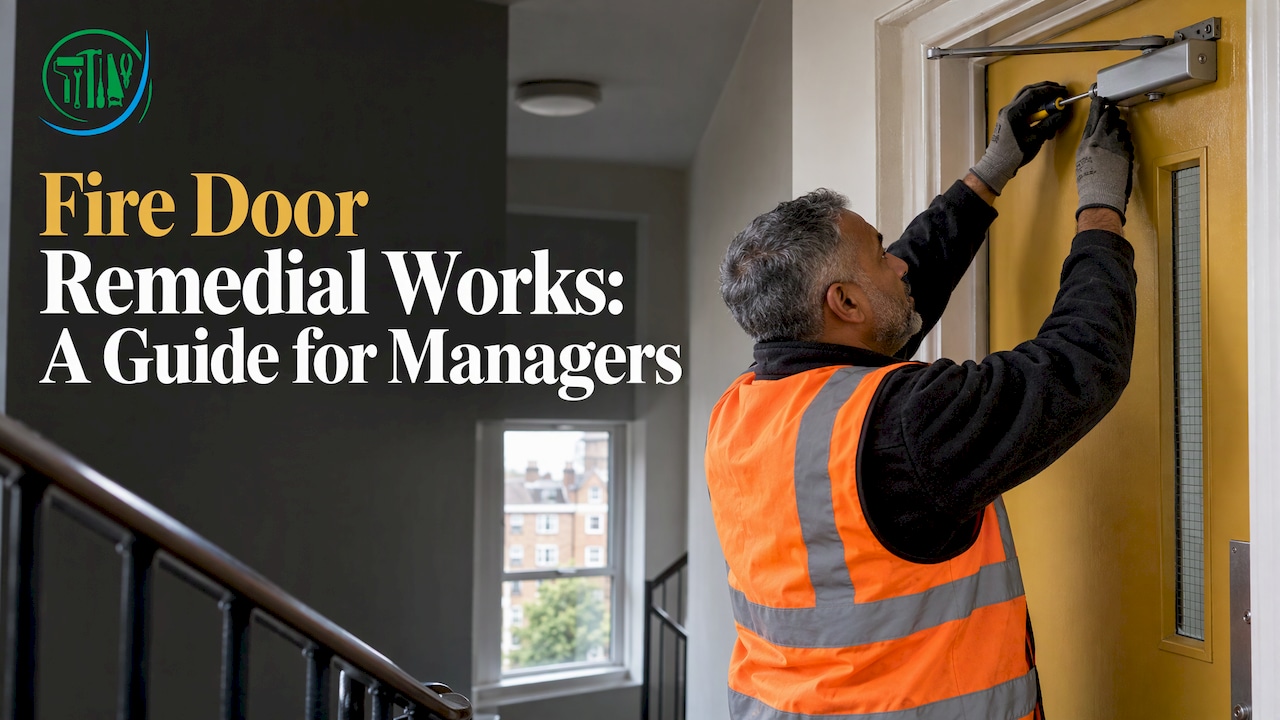
Fire door remedial works are the repairs, adjustments and replacements that bring a fire door back to a condition where it can hold back fire and smoke. After a survey, you sort the defects by risk, have a competent contractor fix them, and keep dated records. This guide shows how to do that for a London block.
TL;DR
- Remedial works means fixing the defects an inspection found so the door performs as a fire door again, by repair where that is sound and by replacement where it is not.
- Sort a long survey into three groups: make safe now, fix within a set window, and plan. Doors that cannot close, damaged glazing and exposed cores come first.
- Under Regulation 10, repairs or replacements an inspection identifies must be done by a competent contractor as soon as reasonably practicable.
- Keep before and after photos, the part specifications and the door reference against each defect.
- Use the worked schedule below as a template for your own 30-defect survey.
Table of Contents
- What are fire door remedial works?
- Which defects does a survey usually turn up?
- Do the Fire Safety (England) Regulations 2022 apply to my block?
- Should I repair or replace the door?
- How do I turn 30 defects into a remedial schedule?
- Who is allowed to carry out the repairs?
- What parts and certification should I ask for?
- Why does photo evidence matter?
- What do we think a manager should do first?
- Can BW Building Maintenance carry out the remedial works?
- How do I keep the doors compliant after the works?
- FAQ
- Sources
What are fire door remedial works?
In one line: remedial works are the corrective work that returns an existing fire door, frame and ironmongery to a compliant, working condition after a defect has been found.
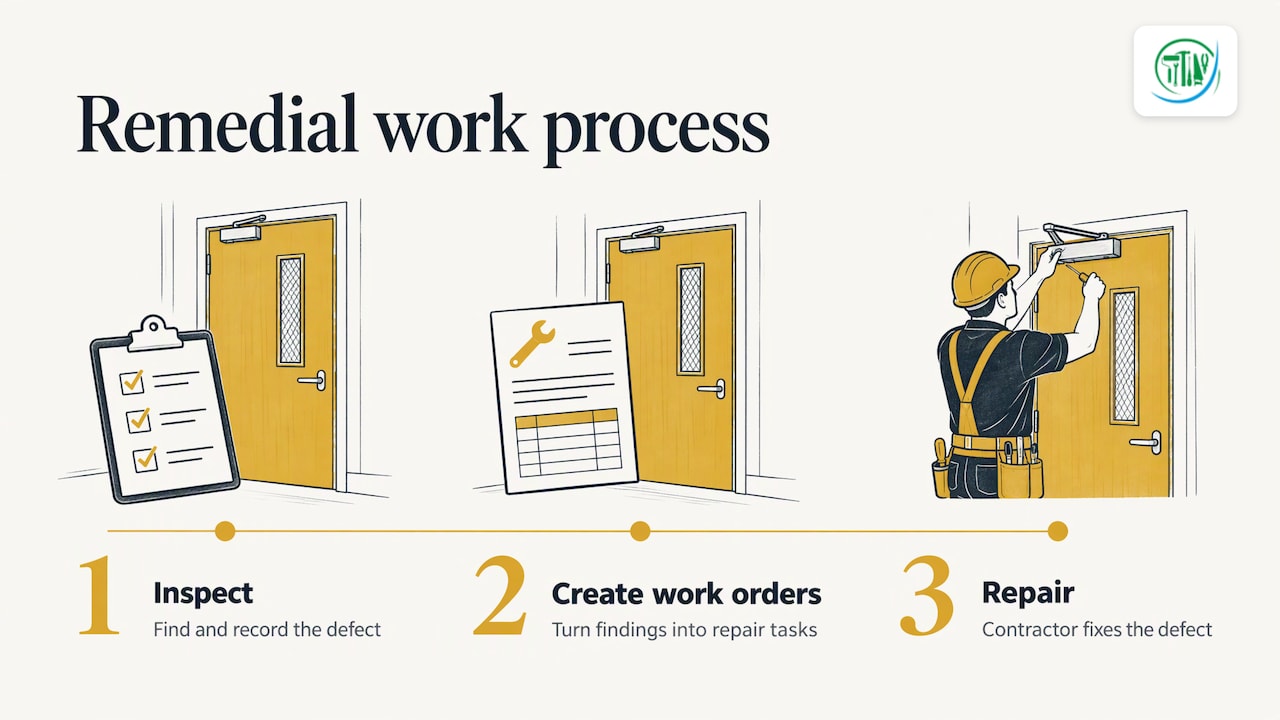
That is different from inspection. An inspector finds and records the problem. A remedial contractor fixes it. Many surveys list defects in a table with a photo and a short note, and it is then up to you, as the person responsible for the building, to turn that list into work orders.
The GOV.UK fire door guidance sets the standard you are working to: fire doors should be kept in good working order and good repair, and defects must not materially undermine their ability to prevent the spread of fire and smoke. For what an inspection involves and how often to commission one, see our guide to fire door inspections.
Which defects does a survey usually turn up?
The same handful of faults account for most of a long survey. The GOV.UK checklist groups its checks under the following headings, and a good survey will mirror them:
- damage or defects to the door, frame or the wall it sits in
- letterboxes
- glazing
- hinges and other ironmongery
- strips and seals
- gaps around the door
- self-closing devices
- alterations, and doors wedged open
Here is what each means on site.
Gaps
The guidance gives the industry standard for the gap between door and frame as no more than 4mm, except at the bottom, where the gap should be as small as practicable while keeping the door unlikely to snag on the floor. Gaps open up when hinges drop, frames move or a door is planed to fit a swollen floor finish. Adjusting hinges often fixes it. A door that has been planed too far may need a new leaf.
Intumescent strips and smoke seals
Strips and seals are the most common repair in older London stock. They get painted over, torn out when a door is rehung, or are simply missing. Replacement means fitting the right strip for that door, in the right groove, not any strip that fits.
Self-closing devices
A door that does not close fully into its latch is not working as a fire door. Closers fail through wear, loose fixings, wrong adjustment or removal by residents. Closers on communal doors in older blocks often have the most wear, because they are used hardest.
Hinges and ironmongery
Missing screws, a missing hinge, a worn hinge pin or unsuitable replacement hardware all show up. Ironmongery is replaced like for like with parts suitable for use on fire doors, not whatever is on the van.
Glazing
Cracked panes, missing beads and unknown replacement glass need attention. Fire-resisting glazing is part of the door’s tested performance, so a replacement pane has to be the right product, installed the right way.
Letterboxes and signage
The guidance says a new letterbox fitted to a door should be suitable for use in fire-resisting doors and fitted by a specialist contractor. Signage, such as keep shut notices, does not change the door’s performance, but it supports the instructions you owe residents and is a quick, cheap fix.
Do the Fire Safety (England) Regulations 2022 apply to my block?
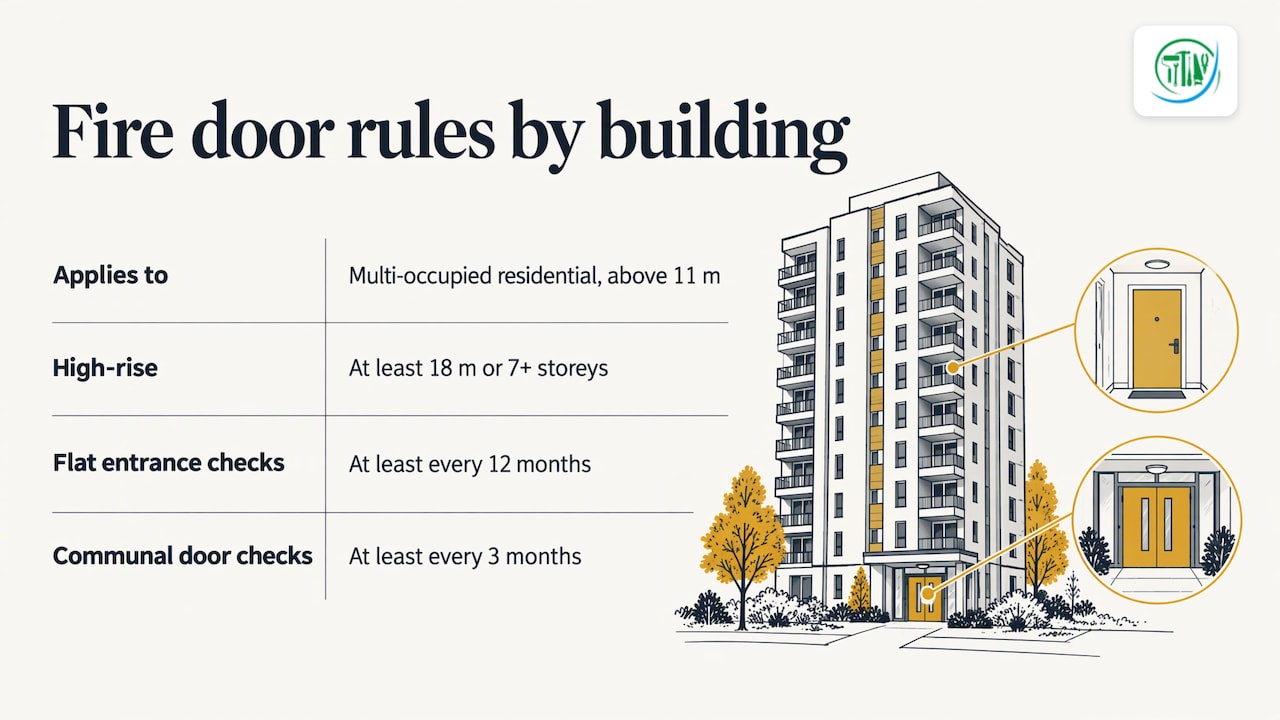
They apply to multi-occupied residential buildings, with the door checks tied to height. The explanatory note to the regulations says the fire door check requirements apply to all multi-occupied residential buildings with storeys above 11 metres. It defines high-rise as at least 18 metres or seven or more storeys.
For those buildings, Regulation 10 sets out what responsible persons must do. According to the GOV.UK guidance, they must use best endeavours to check flat entrance fire doors at least every 12 months and communal fire doors at least every 3 months. They must also give residents fire safety instructions and information about the importance of fire doors.
The same guidance says repairs or replacements an inspection identifies must be carried out by a competent contractor as soon as reasonably practicable. There is no fixed number of days in the wording. That phrase is the legal test, and your documented plan is how you show you met it.
For shorter residential blocks, offices, shops and other non-domestic buildings, your duties as the responsible person come from the Regulatory Reform (Fire Safety) Order 2005, and your fire risk assessment sets what is expected for your doors. If you are unsure which regime covers a mixed-use building in your borough, ask your fire risk assessor.
Should I repair or replace the door?
Repair when the door leaf, frame and fire-resisting properties are sound and the fault is in a part you can swap or adjust. Replace when the door’s performance cannot be restored with confidence.
The GOV.UK fact sheet on fire doors under Regulation 10 says there is no requirement to replace a fire door only because it falls short of current building regulations standards, provided it remains in full working order from a fire safety point of view. It also says that where faults are found, the answer may be maintenance to keep the door fit for purpose or, where needed, replacement.
In practice, these are the tests managers use:
| Situation | Usual route |
|---|---|
| Worn closer, loose hinge screws, missing strip | Repair with suitable parts |
| Gap over 4mm that hinge adjustment can close | Repair |
| Painted-over or damaged seals | Repair: replace seals |
| Cracked or missing glazing | Repair if the glazing system can be restored with the correct product; otherwise replace the door |
| Split leaf, exposed core, large damaged area | Replace |
| Door with no visible rating and no trace of its origin | Refer to your fire risk assessor, likely replace |
| Flat door swapped for a non-fire-resisting door | Replace; see the guidance on residents’ replacement doors |
On that last row, the guidance says that where there is doubt about a replacement flat entrance door, the resident needs to confirm it is fire-resisting, was installed by a competent person, and provide its technical information to the responsible person. Your fire risk assessor may also recommend improvements to doors, and it is for you to decide how to implement them.
How do I turn 30 defects into a remedial schedule?
Sort them by what could happen if the door failed tomorrow, not by the order the surveyor walked the building. Below is an illustration, not a real case: a purpose-built block in Hackney, with a survey of 30 defects across communal doors and flat entrance doors.
Worked example 1: a purpose-built block in Hackney
The surveyor has logged 30 defects across the stair doors, lobby doors and flat entrances. Group them into three bands:
| Band | Defects | Number | Why this band |
|---|---|---|---|
| Now: make safe straight away | Closers missing or failing to latch communal doors | 4 | A door that does not close does nothing in a fire |
| Now | Cracked or missing glazing panels | 2 | The glazing is part of the door’s performance |
| Now | Leaf damaged with core exposed | 1 | Performance cannot be assumed |
| Now | Flat door replaced with a non-fire door | 1 | Needs a decision on replacement and the resident’s records |
| 28 days | Intumescent strips or smoke seals missing or damaged | 6 | Quick repair, parts needed |
| 28 days | Gaps over 4mm at head or jambs | 4 | Hinge adjustment or re-hang |
| 28 days | Loose, worn or missing hinges and screws | 3 | Like for like with suitable parts |
| 28 days | Letterbox not suitable for a fire door | 1 | Specialist fitting |
| Planned | Missing or faded fire door signage | 3 | Low risk, low effort |
| Planned | Painted-over seals needing strip back | 2 | Bundle with decoration cycle |
| Planned | Worn ironmongery to replace with matching parts | 2 | Order in bulk |
| Planned | One door leaf to replace (lead time on a made-to-order leaf) | 1 | Needs a specified door and an access date |
That is 8 defects in the first band, 14 in the second and 8 in the third, which adds up to 30.
A few notes on the schedule:
- The 28-day window is a working target, not a legal deadline. The regulations say as soon as reasonably practicable. Choose a window you can defend and write down why.
- The Now band is about making safe. If a door cannot be fixed straight away, record what interim control you put in place and who agreed it. Your fire risk assessor can advise on temporary measures.
- Fix in clusters. Send one operative to a floor and complete all defects on every door there. This cuts visits to residents.
The guidance notes that checks of flat entrance doors need access to each flat, so arrangements should be made with residents in advance, and offering a range of times helps. In a larger block, it is unlikely every door can be checked on one occasion. The same applies to repairs.
Worked example 2: a Southwark office floor
Again an illustration. A managing agent holds a survey for a multi-let office building in Southwark: 11 defects, all on corridor and riser doors. Four closers need adjusting or replacing, three doors have been wedged open with door stops for deliveries, two have damaged seals and two have missing signage.
The wedged doors are a management issue as well as a repair one. Remove the wedges, check the doors close, and speak to the tenants about delivery routes. The GOV.UK checklist lists wedged-open doors as a check item for a reason. Fit closers first, then seals, then signage. An office of this size can usually be cleared in a single planned visit once parts are on site, with work agreed out of hours if tenants prefer.
Who is allowed to carry out the repairs?
A competent contractor. The guidance does not name a scheme, but it is clear on the principle: repairs and replacements an inspection identifies must be done by a competent contractor. Whether the person who checked the doors can also fix them depends on their skills, knowledge and experience.
What competent looks like in practice:
- they can tell you the door’s rating and what parts suit it
- they fit parts suitable for fire doors, with the manufacturer’s installation requirements to hand
- they record what they did, door by door
- they work under your site rules, including access, permits and out-of-hours arrangements
For works in plant rooms, risers or roof-level doors, a permit may be needed. Our guide to the permit to work system explains how that fits around maintenance visits.
What parts and certification should I ask for?
Ask for parts suitable for use in fire-resisting doors, and ask for the product details to be recorded against each door. The guidance says modern fire doors should display a visible fire resistance rating, and for doubtful replacement flat doors it expects technical information to be passed to the responsible person.
A practical file for each remediated door includes:
- door reference and location
- defect found, with the surveyor’s photo
- work done, date and who did it
- parts fitted and their product details
- after photo
- any follow-up, such as a replacement on order
The GOV.UK checklist already gives you fields for the issue, the proposed action, timescales and the person responsible. Use the same headings in your schedule, so the survey, the work orders and the completion record line up.
Why does photo evidence matter?
Because it shows what you found and what you fixed, door by door. If a resident, a tenant, an insurer or an enforcing authority asks what happened to door 4.12, a dated before and after photo with the part details answers it in a minute.
Take the after photo from the same angle as the surveyor’s. Capture the gap, the seal, the closer and the label or rating mark where visible. Name the files with the door reference. Store them with the survey, not in someone’s phone.
This record also supports your arguments if disrepair is alleged. Our article on preventing housing disrepair claims covers how a clear repair record helps landlords.
What do we think a manager should do first?
We find that a long survey feels heavier than it is. Thirty defects sound like thirty jobs, but on site they are usually a dozen visits once you group them by floor and by part.
Our advice is to settle three things before anyone picks up a tool: the order of priority, the standard of part you will accept, and the record you want at the end. Then the work itself is routine.
This is where one contract with our own trade teams helps. Carpenters, painters and general maintenance operatives work to one schedule, report through one channel, and you receive one monthly report and one consolidated invoice. Door repairs sit alongside the rest of the building’s work, instead of becoming a separate project with its own paperwork.
We carry out the remedial works. We do not carry out the inspection, and we would not want to mark our own homework. Your inspector finds the defects, we fix them, and your records show both.
BW Building Maintenance
Can BW Building Maintenance carry out the remedial works?
Yes. BW Building Maintenance is a London contractor that carries out compliance-related remedial works, including repairs to doors, frames and ironmongery, under one contract with its own trade teams. Operatives are DBS-checked, and BW is SafeContractor approved and CHAS accredited. We work from your survey, not instead of it: you hand over the inspector’s report, and we agree a schedule against it.
Every contract starts with a site survey and an agreed schedule of rates and SLA, and runs through one reporting channel, with a monthly report and one consolidated invoice. See how the contract options work, or look at the full list of services for the other trades we cover.

For blocks across boroughs such as Hackney, Southwark, Lambeth and Tower Hamlets, and for converted period houses, mixed-use buildings and offices, the approach is the same: survey, prioritise, repair, record.
How do I keep the doors compliant after the works?
By checking them on a routine, recording what you find, and dealing with new defects before they pile up. Under Regulation 10, for buildings it covers, that means checking flat entrance doors at least every 12 months and communal doors at least every 3 months, using best endeavours, as the GOV.UK guidance sets out.
The GOV.UK fact sheet says that routine checks need not be done by a specialist, and the responsible person should be able to carry them out. The minimum is an inspection to identify obvious damage or issues. A detailed technical examination of fire resistance is a matter for the fire risk assessment, unless a flat door appears to have been swapped for a non-fire-resisting one or is visibly damaged in a way that affects performance.
A few habits make the next survey shorter:
- fit closers that suit the door and the traffic, and check them at each visit
- repaint without painting over seals or hinges
- tell contractors, tenants and residents not to wedge doors open
- put the door reference on every work order
- feed the fire risk assessment’s door recommendations into your planned maintenance schedule
Void turnarounds are a good point to check every flat entrance door in an empty home. Our void property standards checklist shows how to build that into re-letting.
FAQ
What is the difference between fire door remedial works and fire door replacement?
Remedial works repair or adjust an existing door, for example by fitting new seals, adjusting a closer or re-hanging on sound hinges. Replacement swaps the whole door set or leaf. GOV.UK says a door need not be replaced only because it falls short of current standards if it remains in full working order from a fire safety point of view, so repair is often the right route where the door is sound.
How quickly must fire door defects be fixed?
The Fire Safety (England) Regulations 2022 guidance says repairs or replacements identified by an inspection must be done by a competent contractor as soon as reasonably practicable. It gives no number of days. Set priorities in writing, deal with doors that cannot close first, and record the reasons for your timings.
Do I need a specialist to check my fire doors?
For the routine checks under Regulation 10, the GOV.UK fact sheet says it should not be necessary to engage a specialist, and the responsible person should be able to carry them out. Repairs and replacements are different: they need a competent contractor. Your fire risk assessor deals with detailed questions about a door’s fire resistance.
What records should I keep after remedial works?
Keep the survey, the door reference, a before and after photo, the work done and the date, the parts fitted with their product details, and who did the work. The GOV.UK checklist includes fields for the issue, proposed action, timescales and the person responsible, so use those headings to keep everything in one place.
Sources
- Fire Safety (England) Regulations 2022: fire door guidance
- Fact sheet: Fire doors (regulation 10)
- Explanatory note, Fire Safety (England) Regulations 2022 (SI 2022/547)
- Regulatory Reform (Fire Safety) Order 2005
Email info@bwbuildingmaintenance.co.uk or message BW on WhatsApp for a quote or to report a repair.