Commercial Plumber Services in London

Commercial plumber services cover reactive repairs (leaks, blocked drains, failed toilets, pressure faults) and planned maintenance of pipework, tanks, valves and drainage in offices, shops, mixed-use buildings and residential blocks. For London managing agents and facilities managers, the best results come from one accountable contractor, with records, insurance and method statements.
TL;DR
- Commercial plumbing splits into reactive work (something has failed) and planned work (inspection and servicing that stops failures). You need both.
- The common call-outs are leaks, blocked drains, toilet and washroom faults, and water pressure or temperature problems.
- A competent contractor provides RAMS, proof of insurance, qualified operatives and written records for every visit.
- Duty to maintain water systems stays with whoever controls the premises, so appointing a contractor does not hand that duty away.
- One multi-trade contract usually means fewer chasing calls, one report and one invoice, compared with a list of separate plumbers.
Table of Contents
- What do commercial plumber services actually cover?
- What is the difference between reactive and planned commercial plumbing?
- Which plumbing call-outs do London buildings see most?
- What should you do while waiting for an emergency plumber?
- What should a good commercial plumber provide?
- Which UK rules affect commercial plumbing and water systems?
- How does a London block or office plan plumbing work with minimal disruption?
- Why does one multi-trade contract beat several separate plumbers?
- What is our view on commercial plumbing contracts?
- How does BW Building Maintenance deliver commercial plumbing?
- How do you keep plumbing costs predictable?
- FAQ
- Sources
What do commercial plumber services actually cover?
Commercial plumbing is not domestic plumbing on a bigger scale. The pipework is longer, the systems are shared, and a fault in one riser can affect a dozen tenants or a whole trading floor. A typical scope for a London building includes:
- Leak detection and repair on supply pipes, waste pipes, risers, stopcocks and valves.
- Drainage: clearing blocked drains and gullies, repairing broken or displaced sections, and keeping external drains running in the rain.
- Washrooms: cisterns, taps, urinal controls, macerators, trap seals and flushing faults.
- Hot and cold water systems: tanks, cylinders, pumps, thermostatic mixing valves and temperature faults.
- Heating-related plumbing: radiators, pipework, pressurisation and bleeding, as part of a wider building service.
- Minor alterations: moving a sink, adding a tap or capping off redundant pipework during a refit.
What makes it commercial is the way the work is managed. You need access arrangements for tenants, out-of-hours working in occupied offices, permits for certain tasks, and a record you can hand to an insurer or a freeholder.
What is the difference between reactive and planned commercial plumbing?
Reactive plumbing is the call-out: a ceiling is dripping, a toilet block is out of use, a drain has backed up. Planned plumbing is scheduled attention to the same assets before they fail.
The two are not alternatives. Guidance on servicing and maintenance from the North East & Yorkshire Net Zero Hub points out that planned preventative maintenance helps keep breakdowns and emergencies to a minimum, but it should be backed by an effective way of identifying, reporting, prioritising and completing urgent repairs, because no maintenance system rules out failures altogether.
| Reactive plumbing | Planned plumbing | |
|---|---|---|
| Trigger | A fault is reported | A schedule set by building use and systems |
| Typical tasks | Burst or leaking pipes, blocked drains, toilet faults | Valve and pipework checks, tank inspection, drain jetting, temperature checks |
| Cost pattern | Unpredictable, often out-of-hours | Easier to budget and service-charge |
| Tenant impact | Disruption at short notice | Notified in advance, done at quiet times |
| Record produced | Job report and photos | Inspection log and trend of recurring faults |
For intervals that catch leaks early, see our guide to commercial plumbing maintenance. The Water Regs UK maintenance leaflet refers to inspection frequencies in BS EN 806 Part 5, including annual checks for pipework and check valves. Your own schedule should follow the system, the building and its use, not a generic calendar.
Which plumbing call-outs do London buildings see most?
Leaks and burst pipes
In older London stock, such as converted period houses split into flats or Victorian mixed-use parades with shops below and flats above, leaks often start at joints, old stopcocks or pipes boxed into walls. In newer purpose-built blocks, the culprits tend to be riser connections, pressed fittings and failed isolation valves. A good first response isolates the section, protects the area, and then diagnoses the cause rather than patching the symptom.
Blocked drains and backing-up toilets
Shared drains take the load of many users. Grease from ground-floor food outlets, wipes in washrooms and silt in external gullies are the usual causes. Repeat blockages in the same run are a signal to survey the drain rather than to clear it again.
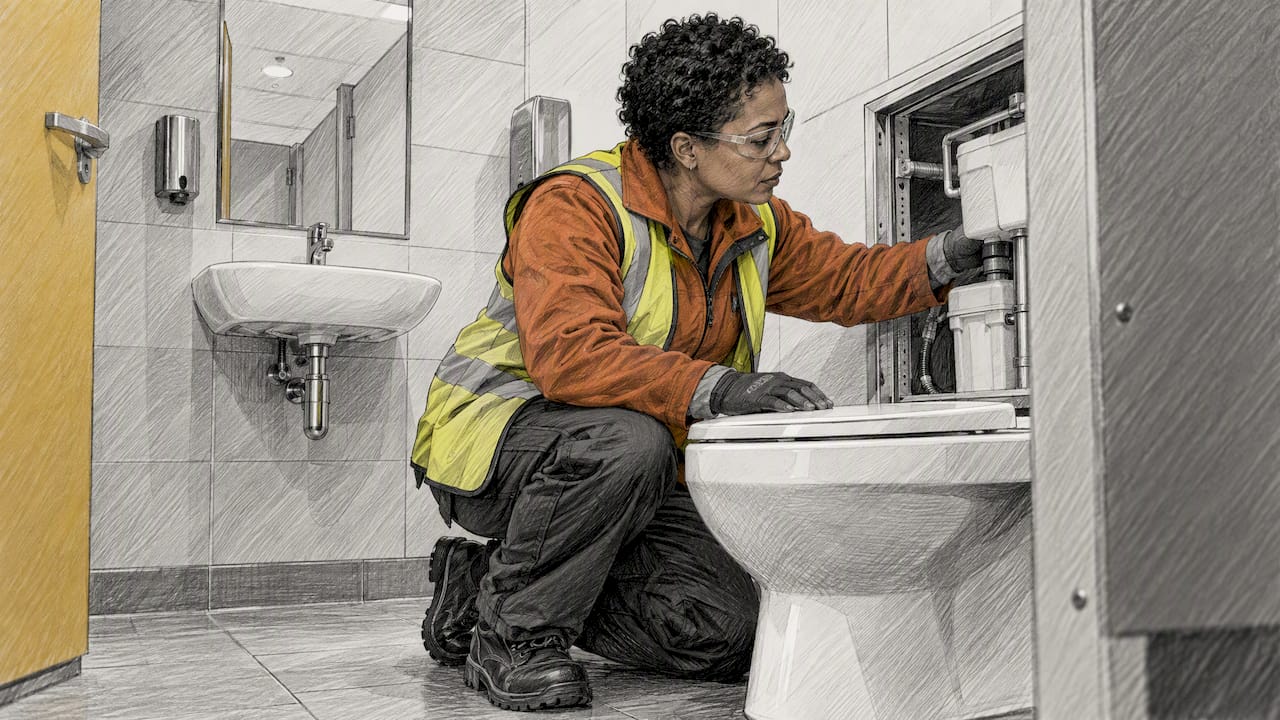
Toilet, tap and washroom faults
Washrooms are what staff, tenants and customers notice first. Faulty flushes, running cisterns and slow-filling basins create complaints quickly. They are cheap faults to prevent through routine checks and expensive in goodwill if left.
Water pressure and temperature problems
Low pressure on upper floors, hot water that never reaches temperature, or sudden pressure drops often trace to pumps, valves, scaled-up heaters or blocked strainers. They also touch water hygiene, covered below.
What should you do while waiting for an emergency plumber?
The contractor needs to arrive, but the first few minutes are yours. Sensible steps, in order:
- Protect people. Keep occupants away from wet floors and from any water near electrics. If water is reaching sockets, lights or distribution boards, do not touch them and keep the area clear.
- Isolate the water. Know where the stopcock and floor-level isolation valves are, and make sure the on-site team and your out-of-hours contact can reach them. Labelled valves save serious time.
- Contain the spread. Move stock and equipment, use buckets and covers, and open access to lower floors if water is travelling.
- Record it. Take photos, note the time and what was done. This helps the repair, the insurance claim and the later root-cause check.
- Report through one channel. One message with address, access details, a photo and a contact on site is worth more than three phone calls.
If you cannot get the supply off, tell your contractor straight away, and for a risk to life or major electrical hazard use the appropriate emergency services.
What should a good commercial plumber provide?
Specifics matter more than promises. Before you appoint, ask for the following.
- RAMS. Risk assessments and method statements for the task and the site, including work at height, hot work, confined spaces and working in occupied areas.
- Insurance. Evidence of appropriate cover, held as a document rather than stated verbally.
- Competence. Qualified operatives, relevant accreditations and references. The Property Institute’s advice note on employing contractors says clients can check identity, financial position, skills and qualifications, insurance and references.
- Professional standing. Membership of a professional body can help. The CIPHE code of professional standards commits members to act professionally, competently and responsibly and gives clients an independent complaints route.
- Records. A written job report with what was found, what was done, photos and any follow-up recommendation. Records are what make repeat faults visible.
- Safe working practice. Controls over permits, isolation and access. Our note on the permit to work system shows how that works in building maintenance.
One point from the same advice note is often missed: landlords, residents’ management companies and right to manage companies are responsible for appointing competent contractors, and health and safety duties cannot simply be delegated to the contractor. Appointing well and supervising properly are part of the job.
Which UK rules affect commercial plumbing and water systems?
Three areas come up most often.
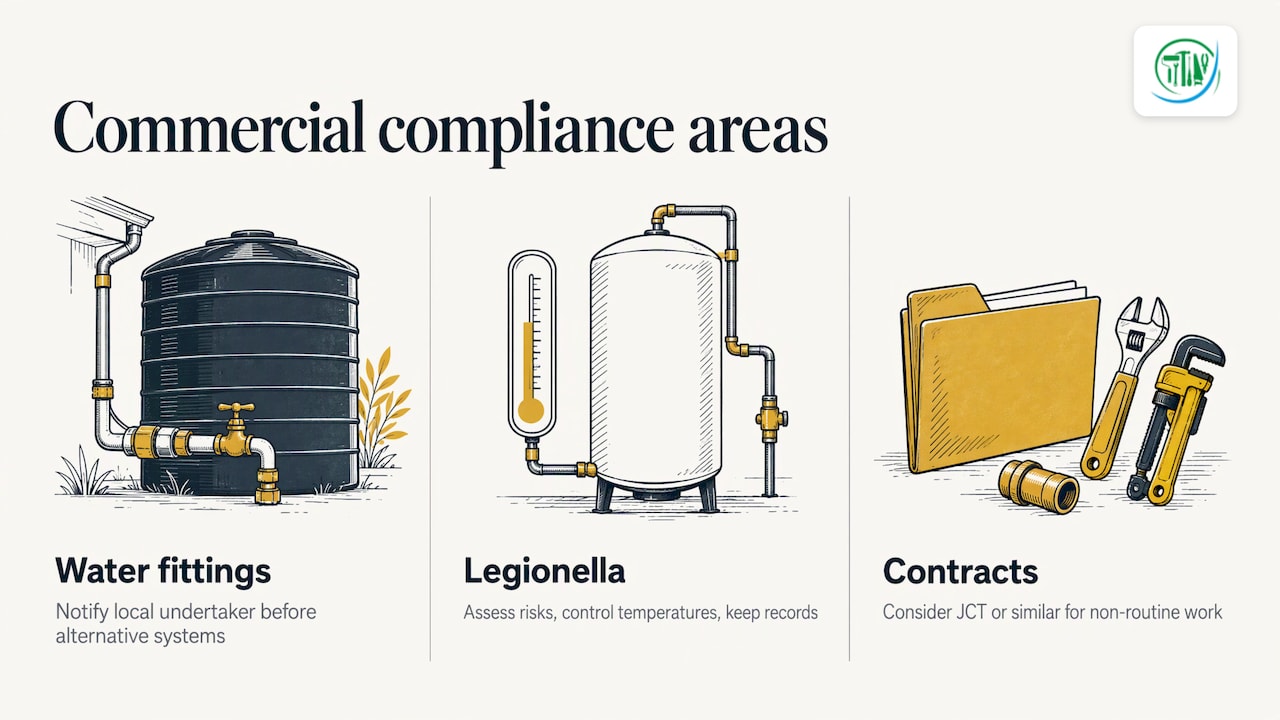
Water fittings. The Water Supply (Water Fittings) Regulations, or byelaws in Scotland, apply to premises with a mains water supply and set legal requirements for fittings and plumbing systems, to protect drinking water (Water Regs UK). Water Regs UK also says proposed alternative water systems, such as rainwater or greywater installations, need advance notification to the local water undertaker (Water Regs UK), described as a free safety check.
Legionella. The HSE’s approved code of practice, L8, says dutyholders, including employers and those in control of premises, should identify and assess sources of risk, prepare a written scheme where appropriate, put precautions in place and monitor them, keep records, and appoint a competent person to help them comply. HSE’s HSG274 Part 1 describes a foreseeable risk where water is stored or recirculated, temperatures may sit between 20 and 45°C, deposits such as scale or rust are present, droplets can be produced and people may be exposed. HSG274 Part 2 says cold water should be kept below 20°C where possible, and hot water stored at 60°C or above and reaching 50°C at outlets within one minute (55°C in healthcare premises). Our guide to legionella risk assessment for building managers explains what dutyholders need to have in place.
Contract terms. For work beyond routine maintenance, or minor work on a scale that requires consultation, The Property Institute advises considering a JCT contract or similar terms, so both parties have a framework if a dispute arises.
How does a London block or office plan plumbing work with minimal disruption?
Planning is mostly about access and timing. Shops and offices need quiet hours; residential blocks need notice to leaseholders and tenants; mixed-use buildings need both. Agree who holds keys, who informs occupants and how out-of-hours access works before the first visit. For larger refits, a phased approach, like the phased works in occupied buildings used on commercial renovations elsewhere, keeps floors or zones in use while others are worked on.
Illustration: a purpose-built block in Hackney
Imagine a 1990s block of 48 flats in Hackney with a shared ground-floor riser cupboard. Three residents report intermittent low pressure on the top two floors, and two ceiling stains appear below a shared bathroom. A reactive-only approach sends a plumber for each report and patches each one. A planned approach checks isolation valves, strainers and the booster pump, finds a partly closed valve and a weeping joint at the same riser, and records both. The result is one visit, one set of photos and one entry in the maintenance log, rather than five unconnected call-outs. This is an illustration, not a case study.
Illustration: a mixed-use building in Southwark
Take a four-storey mixed-use building in Southwark with a restaurant at ground level and offices above. The basement drain blocks every few months. Clearing it each time restores service for a week or two. A survey of the run finds grease build-up and a displaced section, so the fix is a repair plus a scheduled cleaning of the line, agreed with the restaurant. The recurring cost disappears from the reactive budget. Again, this is a worked illustration only.
Why does one multi-trade contract beat several separate plumbers?
Many London property managers hold a loose list: one plumber for leaks, an electrician for the pump supply, a roofer for the gutter that is soaking the wall. When a leak crosses trades, the questions begin. Is it the roof, the pipe, or the decorator who must make good the ceiling?
A single contract removes those handovers.
- One point of accountability when a problem crosses trades, such as a leak that needs a plumber, a carpenter to reinstate boxing and a decorator to make good.
- One reporting route so repairs are logged once and tracked to completion.
- One set of records that shows patterns across the whole building or portfolio.
- Fewer invoices to check, approve and allocate to service charge.
- Consistent standards, with the same checked operatives and the same RAMS approach every time.
The Property Institute’s advice is that work should be properly managed, not just outsourced. A single contractor with a named contract manager makes that management easier, because there is one person to review the record with.
What is our view on commercial plumbing contracts?
We run plumbing as part of a wider maintenance contract, not as a standalone call-out service. In our experience, the buildings with the fewest complaints are the ones where the plumbing, the electrics, the roof and the decorating are reported through the same channel and reviewed together each month.
Our own trade teams, including plumbers, electricians, carpenters, roofers, bricklayers and painters and decorators, mean a leak that touches several trades is one job on one contract, not three negotiations. Every contract starts with a site survey and an agreed schedule of rates and SLA, so planned work and reactive work sit in the same framework from day one.
What managing agents and housing associations tell us they want is simple: fewer surprises and a clear record. That is what planned preventative maintenance, a single reporting channel, a monthly report and one consolidated invoice are built to give.
BW Building Maintenance
How does BW Building Maintenance deliver commercial plumbing?
We cover plumbing, heating and drainage as one part of a full building maintenance contract for commercial buildings, blocks of flats and housing portfolios across London boroughs. Operatives are DBS-checked, and we are SafeContractor approved and CHAS accredited. Each contract runs through one reporting channel, a named contract manager, a monthly review with a report and one consolidated invoice. See the full list on our services section, or read about building maintenance in London.

If you manage offices, retail units, purpose-built blocks or converted period houses and want planned and reactive plumbing under one agreement, start with a site survey. We agree the schedule of rates and SLA with you before work begins.
How do you keep plumbing costs predictable?
Predictability comes from structure, not from hoping nothing breaks.
- Separate planned from reactive in the budget. Planned work can be fixed in advance; reactive work should be covered by agreed rates so there is no negotiation in an emergency.
- Use the records. Review the monthly report for repeat locations. A valve that fails twice is a replacement, not a repair.
- Fix causes. Scale, poor drainage falls and failing pumps keep producing call-outs until addressed.
- Align to service charge. One consolidated invoice makes allocation to cost centres, blocks or tenants simpler and easier to explain.
- Check performance monthly. Look at what was reported, what was closed, what recurred and what is recommended next.
If you want to compare approaches before an enquiry, our blog sets out maintenance intervals and checklists for other building systems too.
FAQ
What is the difference between a commercial and a domestic plumber?
A commercial plumber works on larger, shared and often continuously occupied systems, such as risers, tanks, pumps, multiple washrooms and shared drains. The work comes with more paperwork: RAMS, permits, insurance evidence and written job records. Domestic plumbing is typically a single household with simpler access and reporting.
Who is responsible for water safety in a managed building?
The duty sits with those in control of the premises, such as the employer, landlord or managing agent. HSE’s L8 code of practice says dutyholders should assess risk, keep records and appoint a competent person to help. Appointing a contractor supports this but does not remove the duty.
How do I check a plumbing contractor is competent?
Ask for identity and company details, qualifications, insurance certificates, references and sample RAMS. Professional body membership can add assurance. The Property Institute’s advice on employing contractors lists these checks.
Should reactive and planned plumbing be on the same contract?
Usually yes. Planned inspections reduce failures, while reactive cover handles those that still occur. Holding both under one agreement means the records connect: a call-out can trigger a planned check, and inspection findings can be turned into scheduled repairs.
Can the same contractor handle the other trades after a leak?
A multi-trade contractor with its own teams can. After a leak, the plumber repairs the pipe, a carpenter reinstates boxing or doors, and a painter and decorator makes good the finish, all reported through one channel.
Sources
- The Property Institute: Employing contractors advice note (2018)
- CIPHE: Code of professional standards (2022)
- North East & Yorkshire Net Zero Hub: Servicing and maintenance guidance
- Water Regs UK: Plumbing maintenance leaflet (2025)
- Water Regs UK: Water undertakers and RPZ valves
- Water Regs UK: Alternative water systems guide
- HSE: Legionnaires’ disease, ACOP L8 (2013)
- HSE: HSG274 Part 1 (2024)
- HSE: HSG274 Part 2 (2024)
- Old Ironsides: Commercial construction services
To get a quote or report a repair, email info@bwbuildingmaintenance.co.uk or message BW on WhatsApp.