Planned Preventative Maintenance London: A Guide
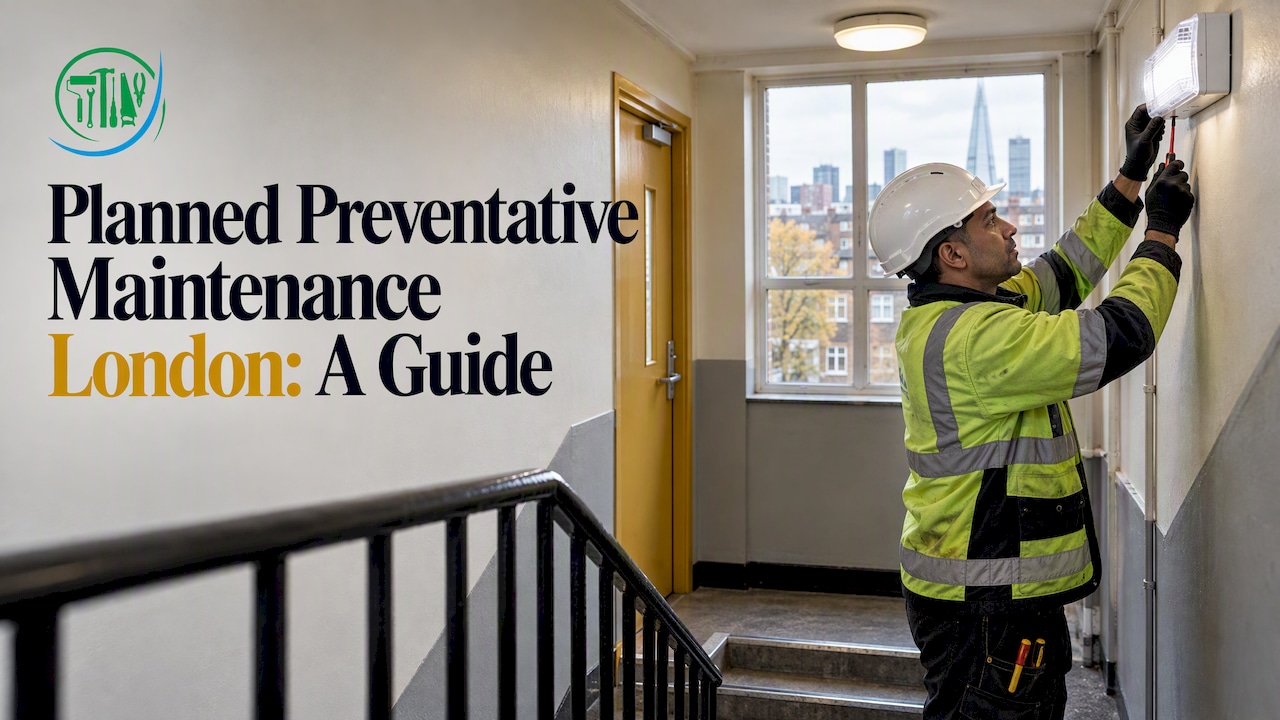
Planned preventative maintenance (PPM) in London is a written programme of scheduled inspections and servicing, covering a building’s fabric, plant and services, so faults are found and fixed before they fail. It sits on an asset list, a calendar and a report, and it replaces most emergency call-outs with booked work.
TL;DR
- PPM means inspecting and servicing every building element on a set calendar, instead of waiting for it to break.
- A good schedule is built from a survey and an asset list, then split by element: roof, façade, services, communal areas and statutory checks.
- Few statutory checks have one fixed interval. Where a named source gives one, use it. Otherwise follow the assessor, the manufacturer and British Standards, and document the reasoning.
- Cost depends on building age, size, plant and access, so agree scope and reporting before you agree a figure.
- One contractor with its own trades, one reporting channel and one monthly invoice makes the programme easier to audit.
Table of Contents
- What is planned preventative maintenance, and how is it different from reactive repairs?
- What does a PPM schedule cover in a London building?
- Which tasks happen how often? A schedule by building element
- How is a PPM contract set up, step by step?
- Does PPM really cut reactive call-outs? Two London illustrations
- What affects the cost of planned maintenance in London?
- How do you choose a PPM contractor in London?
- How does BW Building Maintenance run PPM?
- What is our view on PPM for London property managers?
- FAQ
- Sources
What is planned preventative maintenance, and how is it different from reactive repairs?
RICS describes PPM as regular, purposeful maintenance that keeps a building’s structure, fabric, facilities, plant and equipment in satisfactory operating condition through systematic inspection, detection and correction of failures. The key word is systematic: every item has an owner, a frequency and a record.
Reactive maintenance is the opposite. Research from the US Pacific Northwest National Laboratory notes that reactive work is almost always unscheduled and follows an unpredicted failure, while preventive work uses time-based or usage-based actions to detect or mitigate degradation.
In practice, you need both. PPM does not remove emergencies: a burst pipe in a Lewisham block still happens. What it does is shrink the pool of avoidable failures, such as blocked gutters, worn valves and failed emergency lighting, and make the unavoidable ones easier to handle because the asset records already exist.
What does a PPM schedule cover in a London building?
RICS lists the elements a PPM programme should address: the structure, roofs and rainwater goods, façades, windows and doors, entrances, internal finishes and external areas, plus service installations such as HVAC, electrical supply and distribution, water supply and drainage, plumbing, fire detection and firefighting installations, and lifts.
A public-sector UK maintenance specification shows how wide a full scope can run: an accurate asset register, manufacturer and statutory maintenance, a 52-week maintenance planner, mechanical, electrical and plumbing systems, ventilation, fire systems, lifts, lighting and a reactive response element.
For London’s mixed stock, the building type changes the emphasis:
- Purpose-built blocks (for example 1960s to 1980s estates in Hackney, Newham or Lambeth): communal lighting, dry risers, entrance doors, bin stores, flat roofs, balconies and drainage stacks.
- Converted period houses (Islington, Camden, Ealing): slate or lead roofs, cast-iron rainwater goods, timber sash windows, shared hallways and older electrical installations.
- Mixed-use buildings (a shop below flats on a high street in Croydon or Walthamstow): separate demises, shared roofs and risers, and shopfront and signage fixings.
- Offices (Southwark, the City, Canary Wharf fringes): plant rooms, suspended ceilings, raised floors, toilets, kitchenettes and tenant fit-out interfaces.
Which tasks happen how often? A schedule by building element
There is no universal calendar. The table below gives typical planning intervals used for scheduling, and marks where a named source supports a fixed or stated interval. Anything unmarked is a planning judgement to be confirmed against the manufacturer’s instructions, your insurer and the competent person’s advice.
| Building element | Typical PPM task | Planning frequency |
|---|---|---|
| Roofs and rainwater goods | Visual inspection, clear gutters and outlets, check flashings and fixings | Twice yearly is a common planning interval (see our commercial roof maintenance guide) |
| Façades and brickwork | Pointing, cracks, spalling, sealant and fixings review | Annual walk-round, deeper survey as the programme dictates |
| Windows, doors, locks | Operation, hinges, closers, seals, security hardware | Quarterly to annual |
| Fire doors (communal) | Check gaps, seals, closers, damage | Follow the assessor and fire door inspection guidance |
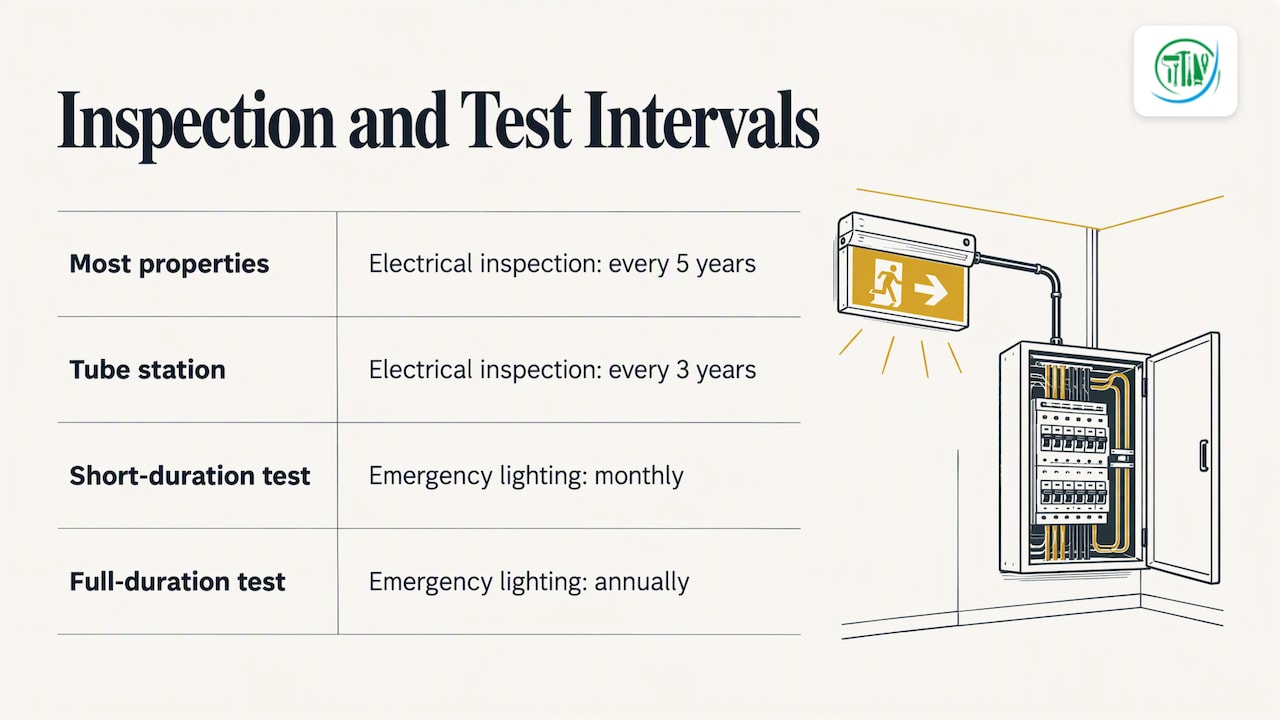
| Fixed electrical installation | Inspection and testing | At least every five years for most properties, as set out in the TfL guide |
| Emergency lighting | Short function test, full-duration test | Monthly short test and annual full-duration test |
| Gas appliances and boilers | Safety check by a Gas Safe registered engineer | Annually |
| Plumbing and drainage | Valves, tanks, pumps, gullies, leak checks | Staged intervals, see our commercial plumbing maintenance guide |
| Internal finishes and communal areas | Decoration, flooring, handrails, make-good | Rolling cycle by condition |
| External areas | Paving, fences, bin stores, drainage runs | Quarterly to annual |
The statutory rows matter most because they carry the strongest consequences. A few are worth explaining.
Electrical and emergency lighting
The TfL Property Compliance Guide sets fixed electrical inspections at least every five years for most properties, and every three years for premises within a Tube station. It also describes monthly short-duration and annual full-duration emergency-lighting tests. That guide is written for TfL’s own estate, so treat it as a clear published benchmark and confirm the interval for your building with your electrical engineer and fire risk assessor. Our electrical maintenance checklist walks through what a visit covers.
Gas
Fire and Rescue guidance for landlords advises annual gas-appliance checks by a Gas Safe registered engineer. Build the certificate date into the calendar with a lead-in period, so access letters go out before the anniversary, not after it.
Fire safety in flats
The Regulatory Reform (Fire Safety) Order 2005 does not prescribe a single frequency for every installation. Guidance from fire and rescue services on flats says equipment and passive protection must be inspected, tested and maintained at appropriate intervals, following British Standards and a documented approach. In other words, your fire risk assessment and a clear paper trail do the heavy lifting.
One council housing example shows what a documented regime can look like: annual smoke-alarm testing, annual gas safety checks, annual sprinkler servicing in high-rise flats, five-yearly electrical inspection and maintained flat-entrance fire doors. Use it as an illustration of scope, not as your own legal interval.
Asbestos, lifts and other specialist items
An asbestos management plan should include the asbestos register, plans for work on asbestos-containing materials and a schedule for monitoring their condition. Lifting equipment is examined under LOLER at specified intervals by a competent person. These are specialist-led items: your PPM calendar should list them with their dates and responsible parties so nothing falls between contractors, and any remedial works that follow can then be scheduled and recorded.
How is a PPM contract set up, step by step?
The set-up decides whether the programme works. Weak scope is the usual cause of failure: RICS warns that unclear scope or limited access and specialist input can leave defects unappraised, so reactive maintenance carries on and planned works are delayed.
- Site survey. Walk every building, including roofs, plant rooms, risers and communal areas. For older stock, a building condition survey gives the baseline.
- Asset list. Record what exists, where, its age and condition. Dover Council’s fire policy stresses accurate stock reconciliation so properties are not omitted from inspection programmes, and the same logic applies to a portfolio.
- Schedule. RICS recommends a spreadsheet with reference, location, element, condition or defect, repair recommendation and forecast years, with risk or priority, comments, budget and photographs as useful additions.
- Horizon. RICS says programmes are usually prepared for five to ten years, may extend to 30, and should be reviewed regularly.
- Scope and terms. The instruction should state services included and excluded, areas inspected or excluded, reporting format, programme, access and safety requirements, fees, variations and payment terms, per the same RICS document.
- Reporting. Agree one channel for jobs, one monthly report and one invoice, so the paper trail is complete when a leaseholder, auditor or insurer asks.
If contractors work on roofs or in plant rooms, add a permit to work system and consider the Work at Height Regulations 2005 in the method statements.
Does PPM really cut reactive call-outs? Two London illustrations
These are illustrations only, not client stories, and the figures are deliberately absent.
Illustration 1: a purpose-built block in Hackney. A managing agent looks after a 1970s block with a flat roof, communal stairwells and shared drainage stacks. Before PPM, gutters are cleared only after a leak is reported, and the stairwell lighting is fixed lamp by lamp as residents complain. Under a PPM schedule, roof and gutter checks are booked before autumn, stack and gully checks follow a cycle, and emergency lighting is tested on its stated cycle. Fewer water-ingress reports arrive, and the ones that do are easier to trace because the asset register shows what was last inspected.

Illustration 2: an office floor in Southwark. A facilities manager runs a multi-let office. Previously, toilet cisterns, door closers and ceiling tiles were repaired when tenants emailed. The new schedule groups these into quarterly rounds, and the electrical inspection is put in the calendar months ahead of its due date. Tenants raise fewer small snags, and the manager walks into the service-charge discussion with a record of what was done and why.
RICS says PPM surveys help owners and investors understand asset condition and plan investment, including service-charge recovery. For block managers, that link to service charges matters: planned works can sit in a budget, whereas emergencies arrive unbudgeted. Where qualifying works exceed the consultation thresholds, our Section 20 consultation guide explains the process.
What affects the cost of planned maintenance in London?
We do not publish prices here, because a fair figure depends on the survey. What drives the budget is consistent across contractors:
- Building age and type. Period conversions with lead roofs and old wiring need more attention than a recent block.
- Size and number of assets. More plant, lifts, risers and communal space means more scheduled tasks.
- Access. Scaffold, rope access, restricted plant rooms and out-of-hours working all add time.
- Scope boundaries. What is included, what is excluded and how variations are priced.
- Statutory items. Specialist testing and certificates add cost, but they sit in the schedule whether or not you outsource the rest.
For scale, a London Fire Commissioner paper estimated an annual fixed cost of £356,730 for a compliance-and-audit contract that included PPM assurance and technical expertise. That is a large public estate, so use it only to see how such costs are framed: as a fixed annual sum for a defined scope.
Floors in lobbies and corridors are a good example of a low-cost item that protects finishes. Many managers pair the PPM calendar with professional floor maintenance so that wear is managed on a schedule too.
How do you choose a PPM contractor in London?
Compare providers on how they deliver, not on the headline promise:
- Own trades or call-out subcontractors? Own teams mean the same faces, consistent standards and clearer accountability.
- Accreditation and vetting. Ask for SafeContractor approval, CHAS accreditation and DBS-checked operatives, and verify them on the scheme databases.
- Reporting. Ask to see a sample monthly report and how defects, photographs and priorities are shown.
- Scope clarity. Check inclusions, exclusions, access assumptions and how variations are agreed against the RICS instruction list above.
- Contract manager. A named person who knows your buildings is worth more than a helpdesk number.
- Fit with your model. If you are weighing a team of your own against a contractor, our outsourced vs in-house comparison sets out the trade-offs.
How does BW Building Maintenance run PPM?
We run planned and reactive maintenance for managing agents, housing associations, portfolio landlords and commercial occupiers across London boroughs, under one contract. Every contract starts with a site survey and an agreed schedule of rates and SLA. Our own handymen, plumbers, electricians, carpenters, roofers, bricklayers, painters and decorators deliver the work, so there is no chain of call-out subcontractors. Jobs come through one reporting channel, we review the contract monthly with a report, and you receive one consolidated invoice. Our operatives are DBS-checked, and we are SafeContractor approved and CHAS accredited. See the full range on our services overview.
Repair reports and quote requests can come in by WhatsApp or email, which keeps the record in one place.

If you manage a block, an office or a mixed portfolio and want planned preventative maintenance under a single contract, our planned and reactive maintenance offer is the place to start.
What is our view on PPM for London property managers?
Most of the complaints managing agents pass on to us trace back to something that could have been seen coming: a gutter, a door closer, a tripped circuit, a sticking lock. A PPM programme turns those into scheduled visits with a name against each one.
We think the contract structure matters as much as the schedule. When one contractor holds every trade, a leak that needs a plumber, a carpenter and a decorator is one job with one record, rather than three call-outs that need chasing. Planned works are agreed up front, reactive repairs sit at agreed rates, and the monthly report shows you what was done, what is outstanding and what is coming.
Our approach is to survey first, agree the schedule with you, and report in one channel. That is designed to give you fewer surprises, a clean audit trail for leaseholders and boards, and a budget you can defend.
BW Building Maintenance
FAQ
How often should a PPM programme be reviewed?
RICS says programmes are usually prepared for five to ten years and should be reviewed and updated regularly. In practice, review the schedule after any major repair, change of use, refurbishment or new survey, and check progress at the monthly contract review.
Is there one legal inspection interval for fire safety in blocks of flats?
No. Fire and Rescue guidance says the Fire Safety Order does not prescribe one universal frequency. You should follow your fire risk assessment, relevant British Standards and a documented system. Ask your assessor to confirm intervals for each installation.
What should a PPM schedule include as a minimum?
A reference, location, element, condition or defect, repair recommendation and forecast years, as RICS recommends. Add priority, comments, budget and photographs. Statutory checks should appear with their dates and the person responsible.
Can PPM and reactive repairs sit in one contract?
Yes, and it is usually simpler. Planned works are scheduled at a fixed contract value, while reactive repairs are handled at agreed rates through the same reporting channel. You get one report and one invoice, so spend is easier to reconcile.
Does PPM cover every building type in London?
The method applies to purpose-built blocks, converted period houses, mixed-use buildings and offices, but the schedule differs. The survey sets what each building needs, which is why scope is agreed before work starts.
Sources
- RICS: Planned preventative maintenance (2022)
- RICS Property Journal: Getting PPM surveys right
- PNNL: Maintenance approaches
- Contracts Finder: public-sector maintenance specification
- TfL Property Compliance Guide (2022)
- Devon and Somerset Fire and Rescue: landlords and property managers
- Hampshire and Isle of Wight Fire and Rescue: fire safety guidance for flats
- Gravesham Borough Council: fire safety in your home
- Dover District Council: fire safety policy
- London Fire Commissioner: facilities management compliance and audit provision
- Floor maintenance
Email info@bwbuildingmaintenance.co.uk or message BW on WhatsApp for a quote or to report a repair.