Electrical Maintenance Checklist for Commercial Buildings
A sound electrical maintenance checklist for a commercial building covers six things: fixed wiring inspection (the EICR), distribution boards and switchgear, RCD and protective device testing, lighting including emergency lighting, portable equipment, and the records that prove it all happened. This guide sets out what to check, who can reasonably do each check, how often the published guidance suggests doing it, and what to do when something fails. It is written for London facilities managers, managing agents and landlords who need a schedule they can defend.
One point matters before the lists. Most of the intervals below are recommendations from guidance bodies, not fixed legal deadlines. The law sets a duty. How you meet it is a judgement you must be able to justify.
TL;DR
- The legal duty is to keep fixed electrical systems in a condition that prevents danger, so far as is reasonably practicable. How often you inspect is your judgement, informed by manufacturer guidance and the building’s risk.
- Published guidance suggests an EICR at least every five years and routine inspections at least annually. Treat these as a baseline and shorten them for harsh, busy or ageing installations.
- Building staff can do user checks and visual inspections if they know what to look for. Testing, board work and EICRs need a competent electrician.
- Emergency lighting has a monthly short test and an annual full-duration test under BS 5266, according to fire service log book guidance.
- Keep dated records of every inspection, test result, defect and repair. They are not a strict legal requirement, but HSE treats them as essential evidence.
Table of Contents
- What the law actually asks of you
- The checklist at a glance
- Visual checks anyone on site can do
- Distribution boards and switchgear
- RCDs and protective devices
- Lighting and emergency lighting
- Portable equipment
- The fixed wiring inspection (EICR)
- Who does what
- Acting on what you find
- Records that stand up to scrutiny
- Turning the checklist into a maintenance plan
- Our perspective: one contract, one record
- How we can help
- FAQ
- Sources
What the law actually asks of you
The starting point is the Electricity at Work Regulations 1989. Regulation 4(2) requires systems to be maintained so as to prevent danger, and that includes regular inspection and, where necessary, testing. The HSE guidance on the Electricity at Work Regulations 1989 is clear that the duty applies so far as is reasonably practicable, and that the frequency of maintenance is a matter for the dutyholder’s judgement. You are expected to gather the information you need, including the equipment manufacturer’s guidance, and decide.
That has two practical consequences.
First, there is no single statutory number to quote to a tenant or an insurer. Technical documents fill the gap. Insurers’ risk guidance points out that because the regulations are high-level, courts and enforcers use BS 7671 and IET Guidance Notes as benchmarks of what a safe installation looks like. So following them is the safest way to show you did what was reasonable. The same Aviva risk guidance on inspection and testing describes a sound compliance strategy as an installation that meets BS 7671, an initial verification, regular planned preventive maintenance, and periodic inspection and testing.
Second, the intervals you adopt should be written down with the reason behind them. The IET is explicit that the initial inspection intervals suggested in Guidance Note 3 are recommendations rather than legal requirements. A documented rationale for why a plant room is checked more often than an office floor is exactly what you want on file.
The checklist at a glance
Use this as a framework, then adjust it for each building. The intervals are guidance, and where a source is cited it is shown in the section that follows.
| Area | What to check | Typical guidance interval | Who |
|---|---|---|---|
| Visible condition, all areas | Damaged sockets, switches, cables, signs of heat, scorching, water ingress | Ongoing, as part of regular walk-rounds | Building staff |
| Distribution boards | Cover and enclosure condition, labelling, clear access, heat, noise, loose connections | Visual walk-round regularly; internal inspection by electrician at periodic inspection | Staff (visual), electrician (internal) |
| RCDs and protective devices | Operation, correct ratings, evidence of nuisance tripping | As set by manufacturer guidance and your risk assessment | Electrician |
| Emergency lighting | Short functional test, then full-duration test | Monthly and annually (BS 5266) | Competent person |
| General and external lighting | Failed lamps, damaged fittings, photocells and timers | Regular walk-rounds | Staff, electrician for repairs |
| Portable equipment | User checks, visual inspection, testing where justified | Based on risk and equipment type | Staff or competent person |
| Fixed wiring | EICR | At least every five years as a baseline | Skilled, competent electrician |
| Records | Test results, defects, remedials, who did what | Updated after every visit | Managing agent or FM |
Visual checks anyone on site can do
The cheapest protection in a commercial building is people who notice things. A regular walk-round does not need a qualified electrician, but it does need a short, written list of what counts as a problem and a clear route for reporting it.
Ask site teams to look for:
- Cracked, broken or loose socket faceplates and switches.
- Scorch marks, discolouration or a smell of burning around outlets, fittings or boards.
- Cables with damaged insulation, trailing across walkways, or run through doors and under mats.
- Multi-way adaptors daisy-chained or overloaded, particularly in tenant fit-outs.
- Water staining near electrical equipment, which links directly to roof and plumbing defects.
- Boards and cupboards that are unlocked, unlabelled or used for storage.
- Anything that hums, buzzes or feels warm.
Staff should report, not repair. The distinction matters: spotting a damaged socket is a user check; opening it up is electrical work. If a defect suggests water is getting in, follow it back to the source. Our guides to commercial roof maintenance and commercial plumbing maintenance cover the checks that stop water reaching your electrics in the first place.
Distribution boards and switchgear
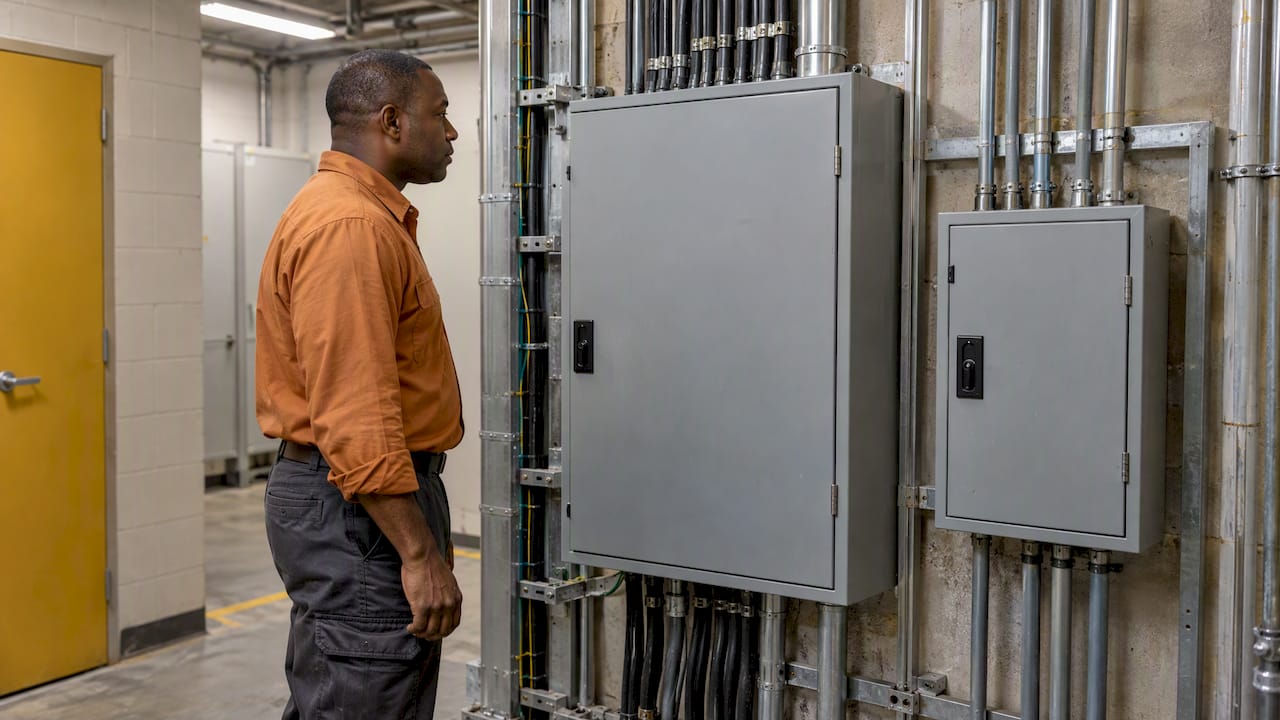
Boards are where small faults become outages. Good practice is to inspect them visually between formal inspections and leave internal work to a competent electrician.
Between formal inspections (visual, from outside):
- Covers and doors are present, closed and undamaged, with no missing blanks in the front of the board.
- Circuits are labelled legibly and the schedule matches what is actually connected.
- Access is clear, with no stored boxes, stock or cleaning equipment in front.
- There is no unusual heat, buzzing, corrosion or moisture.
During periodic inspection (electrician, board isolated):
- Terminations are tight and show no discolouration from overheating.
- Protective devices are correctly rated for the circuit they protect.
- Earthing and bonding connections are present and sound.
- Any additions or alterations since the last inspection are accounted for on the schedules.
Some maintenance regimes add thermal imaging of live boards to spot hot connections before they fail. Whether that is justified depends on how critical the supply is, and it belongs in your risk-based plan rather than a universal checklist.
In a multi-let building, remember that a tenant’s fit-out may have added circuits or a sub-board that never reached your records. A condition review that picks these up is worthwhile, and our overview of commercial building condition surveys shows how that fits into wider planning.
RCDs and protective devices
Residual current devices and circuit breakers are the parts of the installation that are meant to act when something goes wrong, so they are the parts you most want to know work. Check that each one operates as designed, that ratings suit the circuits, and that repeated trips are investigated rather than reset and forgotten. Nuisance tripping is often a symptom: moisture, a failing appliance or a degraded cable.
The honest answer on frequency is again the dutyholder’s judgement, informed by the manufacturer’s instructions for each device. Write the interval you choose into the plan, along with the reason, and have the testing done by an electrician with the right instruments. Record the results by circuit so that next time you can see whether a reading is drifting.
Lighting and emergency lighting
General and external lighting. Check for failed lamps, flickering, damaged diffusers, loose fittings and faulty photocells or timers. These are mostly visual checks, with electricians called in for repairs at height or anything involving the fitting’s wiring.
Emergency lighting. This is the item with the clearest published rhythm. Fire and rescue service log book guidance for non-domestic premises says emergency lighting should be tested monthly by simulating failure of the normal supply, and annually for its full rated duration, in accordance with BS 5266. Every test, and every fitting that fails, should go in the log.
Working at height is the hidden cost here. Replacing a failed fitting in an atrium or stairwell is governed by the Work at Height Regulations 2005, so plan access equipment and a safe system of work rather than leaving a dead fitting for months because reaching it is awkward.
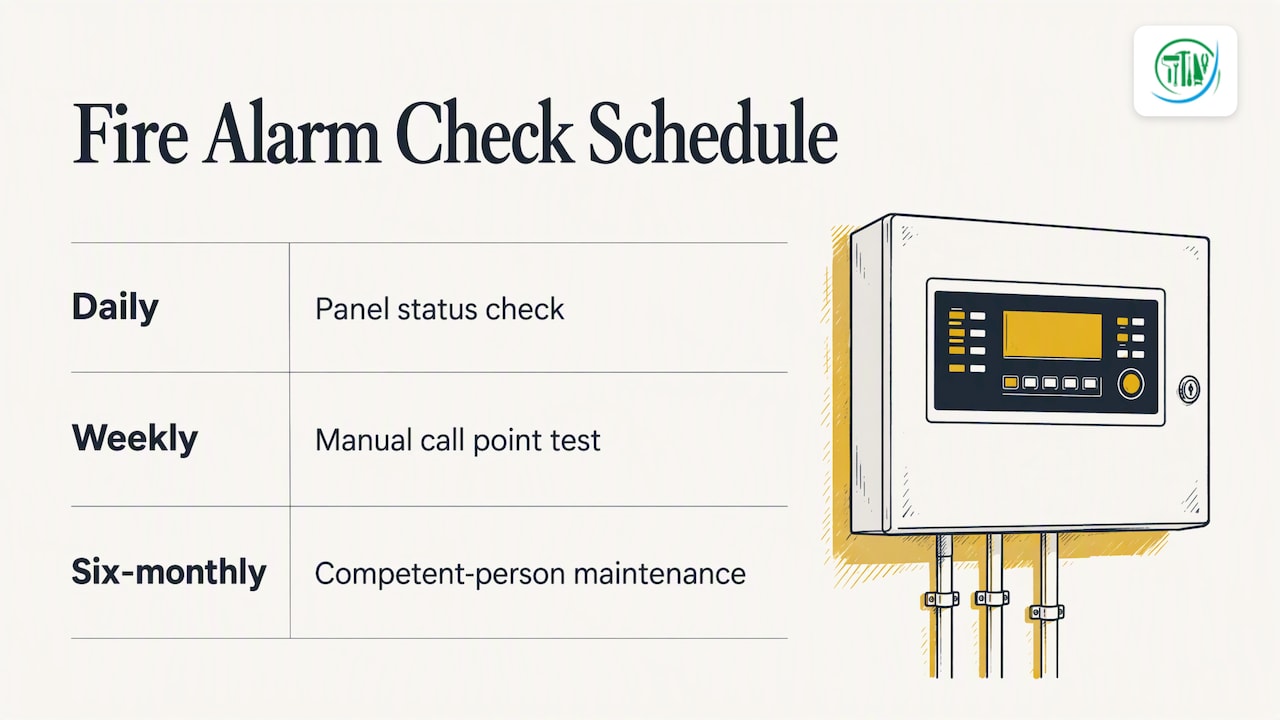
The same log book guidance sets out a rhythm for fire alarm systems: daily panel status checks, weekly manual call point tests, and six-monthly maintenance by a competent person. That sits within your fire safety arrangements under the Regulatory Reform (Fire Safety) Order 2005, and it is worth cross-referencing in your electrical plan so nothing falls between two schedules. It is specialist work, separate from the general electrical checks in this list.
Portable equipment
Portable appliance testing is often over-complicated. HSE’s position is that visual inspection and PAT are not strictly required by law, but they are practical ways of meeting the safety duty. For low-risk environments, users should make a visual check before use, and the HSE guidance on maintaining portable electrical equipment says staff can carry out those user checks and visual inspections if they know what to look for.
Testing is a step further. HSE’s answers to common questions say PAT does not always require a professional electrician: in low-risk settings a competent member of staff with enough training and the right equipment can do combined inspection and testing. The word that matters is competent. In a building where tenants bring their own equipment, set out in the lease or house rules who is responsible for the testing of tenant-owned items, and what you will do about anything visibly unsafe.
A sensible split for managed buildings:
- Landlord-owned equipment (cleaners’ machines, communal kitchen appliances, reception equipment): user checks before use, visual inspections on a set rota, testing as your risk assessment justifies.
- Tenant-owned equipment: the tenant’s responsibility, with evidence requested where your insurer or lease expects it.
- Contractor equipment: contractors should bring their own checked kit, and your induction should say so.
The fixed wiring inspection (EICR)
The EICR is the formal examination of the fixed installation. BS 7671 forms state that it should be carried out at appropriate intervals by a skilled person or persons competent in such work. The word “appropriate” is doing real work: it is the same judgement call as above.
For a baseline, public sector guidance on servicing and maintenance advises that commercial buildings should have an EICR at least every five years, with routine inspections at least annually. Treat this as a starting point, not a statutory deadline. Reasons to inspect sooner include:
- A change of use, a major tenant fit-out or a significant extension.
- Evidence of water ingress, fire, or flooding.
- An installation of unknown age or with incomplete records.
- Repeated tripping, burning smells or failed tests.
- Harsh environments such as plant rooms, car parks, kitchens and external areas.
Before the inspection, agree the scope in writing: which boards, how much of the installation, and whether sampling is acceptable. Aviva’s guidance warns that you cannot hand your legal liability to an electrician. You still have to be satisfied that the contractor is competent and that the agreed scope suits your building. An inspection that covers only a sample of a large, mixed-use building can leave you with a clean certificate and an unexamined risk.
Who does what
A useful rule: look yourself, test with a professional.
- Building staff and site teams: walk-rounds, user checks, visual inspection of portable equipment, logging and reporting.
- Competent electricians: board inspections, protective device testing, EICRs, remedial wiring, anything on or near live conductors.
- Specialist competent persons: emergency lighting and fire alarm testing to the relevant British Standards.
When electricians and other trades share a plant room or ceiling void, a permit to work system keeps isolations, hot work and access under control. Do not rely on a verbal “it’s off”.
Acting on what you find
A checklist is only useful if findings turn into fixes. EICR observations are coded, and the codes drive your response. Under the BS 7671 model forms, observations coded C1 mean danger is present, C2 means potentially dangerous, and C3 is a recommendation for improvement. Aviva’s guidance reads C1 as needing immediate remedial action and C2 as needing urgent remedial action.
In practice:
- C1: make safe straight away. Isolate the circuit if necessary and tell the tenants affected.
- C2: instruct remedial work promptly, and record who authorised it and when it was completed.
- C3: add to the planned programme and budget, ideally alongside other works in the same area.
From your own checks, treat overheating, scorching, failed protective devices and exposed conductors as urgent until an electrician says otherwise. Never leave a known defect open without a documented decision, because the record of what you knew and when is what a regulator or insurer will ask for.
On works involving compliance-related remedials, make sure the contractor is accredited and its operatives are vetted. Our explainer on what to check in CHAS accreditation covers the questions worth asking.
Records that stand up to scrutiny
HSE’s guidance is that keeping records of inspections and tests is not a strict legal requirement under the Electricity at Work Regulations, but maintenance records, including test results, are essential for monitoring the condition of equipment and the effectiveness of your safety arrangements. In an insured, multi-tenanted London building you should treat them as mandatory.
An IET article on setting up a basic electrical maintenance regime suggests recording site visit dates, completed tasks, the responsible operative and any follow-up work needed. For each building, keep:
- The latest EICR, with schedules of circuit details and test results, and the remedial works log.
- Board schedules and drawings, updated after every alteration.
- Emergency lighting test log, with dates, results and defects.
- Portable equipment register, inspections and test results.
- Contractor competence evidence and agreed scopes.
- A defect log showing the date found, code or severity, who was instructed, date closed and certification.
- Meter readings, if you monitor consumption. A sudden change can flag a fault or a failing plant item.
Hold them in one place that a new managing agent or contractor can find. A baseline of earlier results is what lets an electrician see deterioration rather than just a pass or fail.
Turning the checklist into a maintenance plan
The IET advises scheduling work according to the consequences of failure. That is a good test for every item: if this fails, what stops working, who is affected and how quickly can we recover? A lift supply, a data room or a medical tenant’s circuits deserve more frequent attention than a storage unit.
A workable annual plan has four layers:
- Continuous: user reporting and walk-rounds.
- Short cycle: emergency lighting functional tests and logs, and any fire alarm routines your fire risk assessment sets.
- Annual: routine inspection by a competent electrician, emergency lighting full-duration test, portable equipment inspection as risk dictates.
- Periodic: EICR on your chosen interval, with remedials programmed and tracked to closure.
Put dates against each task, name who owns it, and review the plan after every inspection and every significant change to the building.
Our perspective: one contract, one record
The most common electrical failure we see in managed portfolios is not a lack of tests. It is a gap between the people who find a problem and the people who fix it. An EICR lands with C2 observations, the electrician is not the same firm as the one handling the roof leak above the board, and the remedial work sits in an inbox for weeks.
That is why we believe electrical maintenance works best inside a single planned preventative maintenance contract covering all trades, with one named contract manager and monthly reporting. When electrical testing, remedial works and the building fabric are managed together, the water ingress that threatens a board is dealt with alongside the board, and the defect log stays in one place. You get a clear answer to the question a managing agent is always asked: what was found, what was done, and what is still open.
Our operatives are DBS-checked, and we hold SafeContractor and CHAS accreditations, which matters when teams are working in occupied commercial and residential blocks. Whoever carries out your electrical work, insist on the same discipline: a written scope, a competent contractor, results by circuit and a defect log that closes.
— BW Building Maintenance
How we can help
If you would rather have electrical works and testing, planned preventative maintenance and reactive repairs under one contract for your London buildings, see our planned and reactive building maintenance service. It covers electrical works and testing alongside plumbing, heating, roofing, carpentry, decorating and compliance-related remedial works, with a dedicated contract manager for each portfolio.

Because one team handles the trades, a defect found during an electrical inspection can be put right without a second procurement exercise.
FAQ
How often should a commercial building have an EICR?
There is no single statutory interval in the Electricity at Work Regulations. The duty is to maintain the system to prevent danger, and the frequency is your judgement. Public sector guidance advises an EICR at least every five years for commercial buildings, and sooner after a change of use, damage or concerning results.
Do we need to keep electrical maintenance records?
Not as a strict legal requirement under the Electricity at Work Regulations. However, HSE advises that maintenance records, including test results, are essential for monitoring equipment condition and your safety arrangements. In practice, insurers and enforcers will expect to see them.
Can our own staff carry out PAT?
Often yes, in low-risk environments. HSE says a competent person with enough knowledge, training and the right equipment can do inspection and testing, and they do not need to be an electrician. Users can also perform visual checks before use. Higher-risk equipment or settings call for a more specialist approach.
What do C1, C2 and C3 mean on an EICR?
They are observation codes. C1 means danger is present and needs immediate remedial action, C2 means potentially dangerous and needs urgent remedial action, and C3 is a recommendation for improvement. Keep a log showing when each was found and when it was closed.
How often should emergency lighting be tested?
Fire service log book guidance for non-domestic premises says monthly, by simulating failure of the normal supply, and annually for the full rated duration, in line with BS 5266. Record each test and any failures in the log.
Sources
- HSE guidance on the Electricity at Work Regulations 1989
- Aviva risk guidance on inspection and testing
- IET inspection and testing FAQs
- Fire and rescue service log book for non-domestic premises
- HSE: maintaining portable electrical equipment
- HSE: portable appliance testing FAQs
- BS 7671 model forms for certification and reporting
- Servicing and maintenance guidance document
- IET: setting up a basic electrical maintenance regime