Housing Disrepair Claims: How Landlords Can Prevent Them
Most disrepair claims are not caused by one big failure. They grow out of a small defect that was reported, logged badly, fixed late or fixed on the surface only, and then reported again. If you manage homes in London, the way to prevent claims is to catch defects early, fix the cause rather than the symptom, keep records that show what you did and when, and keep residents informed throughout. This article sets out how, with the government’s Awaab’s Law guidance for social landlords as the benchmark for social housing in England.
TL;DR
- Claims usually start with delay, poor communication or a repeat defect, so the best prevention is a repair process that is quick, joined up and visible to the resident.
- Damp and mould need the root cause fixed and documented. Cleaning or painting over mould invites recurrence and a claim.
- Awaab’s Law sets statutory timeframes for social landlords in England, so your triage, investigation and works scheduling must be able to prove they were met.
- Records are your defence: dated reports, photographs before, during and after, contractor invoices and a clear audit trail.
- Fewer contractors and one accountable contract manager make all of the above easier to deliver.
Table of Contents
- Why disrepair claims arise
- Damp and mould: fix the cause, not the stain
- Repair timescales: what the rules expect
- Inspection and record keeping
- Communicating with residents
- Why a single contract helps prevent claims
- Our perspective
- Where our service fits
- A practical prevention checklist
- FAQ
- Sources
Why disrepair claims arise
A landlord’s duty to keep a home in repair is not new, and tenants have long been able to claim when it is not met. What has changed is how visible and how well understood those rights are. Residents can read the same government guidance you can, and many have a clear idea of what “reasonable” looks like before they pick up the phone.
In practice, claims tend to follow the same few patterns:
- A report that goes nowhere. The resident reports a leak or damp patch, hears nothing, and reports it again. By the third contact, they are looking for outside help.
- A repair that does not hold. The visible symptom is dealt with, the cause is not, and the problem returns within weeks.
- Handoffs between trades. A plumber stops the leak, but the plasterer, electrician and decorator are booked separately, weeks apart. The home stays damaged and the resident stays unhappy.
- No evidence. The work was done, but nobody can show when it was reported, who attended or what was found.
- Poor communication. Residents are not told what to expect, so silence reads as neglect.
The government’s guidance on damp and mould for rented housing providers makes a point that applies well beyond mould: respond sensitively and assess the issue with urgency. Each pattern above is a failure of urgency, follow-through or record keeping, not of intent. That is good news, because all three can be managed.
Damp and mould: fix the cause, not the stain
Damp and mould are where many disrepair claims begin, because they are visible, affect health and come back if mishandled. The research behind current guidance is consistent on three points.
Do not stop at surface cleaning. Government guidance is explicit that cleaning or painting over mould without dealing with the underlying structural, insulation or ventilation problem leads to recurrence. A mould wash is a legitimate first step to make a home safe. It is not a repair.
Do not blame the resident. Local authority landlord guidance, including West Lindsey District Council’s proactive landlord procedures, stresses procedures and systematic record keeping over lifestyle advice. Telling a resident to open windows more often, when the real cause is a failed gutter or a blocked extractor, is both unhelpful and the sort of statement that reads badly in a claim.
Do not wait for medical evidence. Landlords should not hold back remedial work while waiting for a doctor’s opinion. Treat the building defect as the priority in its own right.
Common root causes to check
When you investigate, work through the usual sources before deciding the problem is condensation:
- External water ingress: roof coverings, flashings, guttering and downpipes. Our note on commercial roof maintenance and twice-yearly checks applies equally to residential blocks with flat roofs and parapets.
- Leaking or weeping pipework, waste connections and overflows. See the plumbing intervals that catch leaks early.
- Defective ventilation: failed extractor fans, blocked trickle vents, ducting that has detached in a ceiling void.
- Failed or missing damp proofing, and external ground levels built up against walls.
- Poor insulation or cold bridging causing condensation on specific walls or corners.
- Heating that does not work, leaving the home cold and damp.
The government’s guide to the Housing Health and Safety Rating System is the framework councils use to judge hazards in homes, and it is worth knowing how your own stock would be assessed under it.
Make good properly
A claim often cites not just the original defect but the damaged finishes left behind: stained ceilings, blown plaster, bare patches. Close the job completely. That means drying out, treating, re-plastering or patching and decorating, so the resident sees a finished repair rather than a hole with a promise. If you want to understand what plaster and wall repair after water damage involves, this overview of plaster repair and cracking covers the principles of restoring walls and finishes.
Repair timescales: what the rules expect
Speed is the most direct way to prevent a claim, and for social landlords in England it is now partly a matter of statute.
Awaab’s Law timeframes
Under the regulations behind Awaab’s Law, as set out in the government’s timeframes guidance, social landlords must:
- investigate potential emergency hazards, and carry out the relevant safety work, within 24 hours of becoming aware of the hazard;
- investigate potential significant hazards within 10 working days of becoming aware of them.
The same guidance gives an example of a significant damp and mould hazard: an investigation within ten working days, a mould wash to make the home safe within five working days, and continued monitoring while the underlying cause is dealt with. Read the full guidance for your own obligations, including which hazards and which tenancies are in scope, because the rules have been introduced in phases. The phase 2 guidance is clear that the phased approach gives social landlords no leeway on dangerous issues in the meantime: they should keep meeting their legal duties to keep homes safe by fixing disrepair.
These rules apply to social landlords in England. If you manage a mixed portfolio, check which homes fall under them, and do not assume the same deadlines apply elsewhere in the UK.
What a timescale actually requires of your process
The deadline clock starts when you become aware of a hazard, not when someone opens a job on the system. That has practical consequences:
- Every channel counts. A comment to a caretaker, a repairs email, a housing officer’s note and a call to the contact centre are all ways you become aware. They must all reach the same triage point.
- Triage has to be fast and consistent. Someone competent must decide whether a report is a potential emergency, a significant hazard or routine, and record why.
- Access needs managing. If you cannot get in, you need evidence of the attempts you made, not just a “no access” code.
- Timers beat memory. Automated reminders against each statutory window are far safer than a manual diary.
Outside the statute, the courts expect reasonable conduct too. The Pre-Action Protocol for Housing Conditions Claims says a landlord should normally reply to a Letter of Claim within 20 working days of receipt, with relevant records, and that failing to do so is a breach of the Protocol, leaving the tenant free to issue proceedings. The response is expected to cover whether liability is admitted, and a schedule of intended works with dates. If your records are scattered across three contractors, you will struggle to meet that expectation. If you ever receive a letter, take legal advice from a housing solicitor straight away.
Inspection and record keeping
The most effective claims defence is a good paper trail created at the time, not reconstructed later. Treat records as a live operational tool, not a filing exercise.
What to capture on every defect
| Stage | Record |
|---|---|
| Report | Date and time received, channel, who reported, exact words used, access details |
| Triage | Category chosen (emergency, significant, routine) and the reason |
| Investigation | Date attended, operative name, findings, moisture readings where taken, photographs |
| Works | Scope, start and completion dates, photographs during and after, materials used |
| Root cause | What caused the defect and what was done to stop it recurring |
| Follow-up | Post-completion check, resident contacted, outcome noted |
| Costs | Contractor invoices linked to the job |
Photographs matter most. A dated image of the problem before work, the work in progress and the finished repair is far more persuasive than a note saying “completed”.
Check that repairs have held
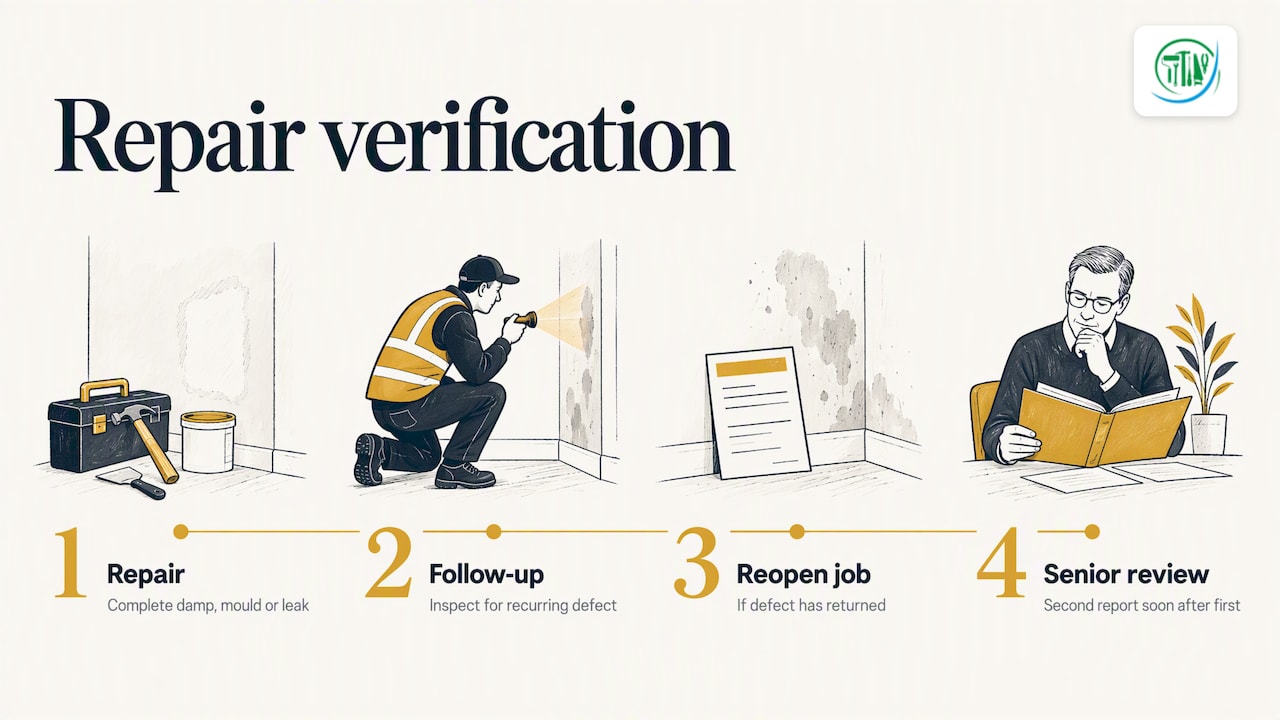
A repair is only proven when the problem has not returned. Build a follow-up inspection into every damp, mould or leak job, and reopen it if the defect has reappeared. The statutory guidance example above includes continued monitoring for exactly this reason. A repeat report on the same defect is one of the strongest signals a claim is coming, so flag any address with a second report in a short period for a senior review.
Inspect before residents have to tell you
Many landlords wait to be told. The better approach is the one West Lindsey’s guidance describes: look for damp and mould every time you visit, even when that is not why you are there. A visit for another purpose, or a routine walk through a communal area, is a chance to spot a failing gutter, a stained ceiling or a blocked vent before it becomes a hazard.
Sensible routines for a London block portfolio include:
- planned condition checks of roofs, gutters, external walls and communal areas, supported by a commercial building condition survey where you need a baseline;
- operatives trained to report anything they notice on site, whatever their trade;
- a standard template across all contractors, so data can be compared and patterns found.
Consistent records let you analyse stock data, find recurring failure points such as guttering or ventilation, and act before a resident reports anything. Do not invent inspection intervals of your own for statutory checks. Where a legal interval applies, such as gas safety, check the regulator’s page. The HSE explains what a gas safety record must contain, and keeping those standards helps if your files are ever scrutinised.
Communicating with residents
Claims are often as much about feeling ignored as about the defect. Local guidance on damp and mould notes that when processes are accessible, transparent and prompt, residents are less likely to look for outside legal help. That is an inference worth acting on.
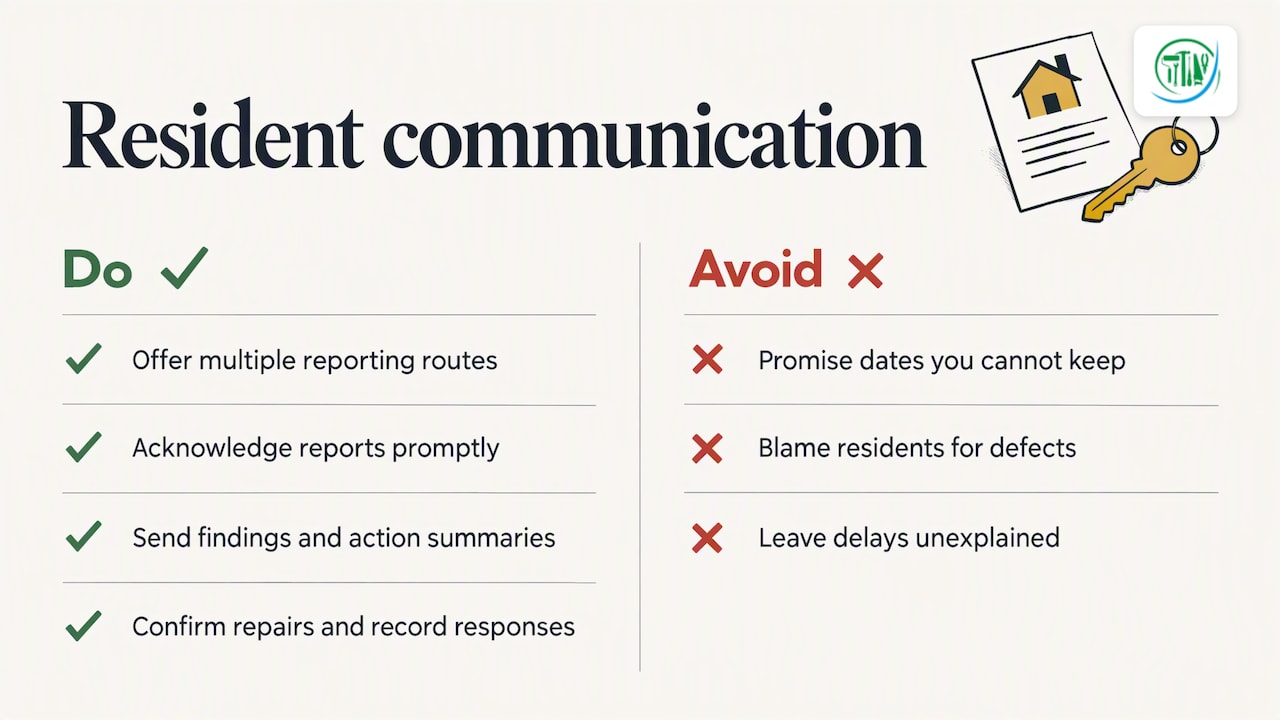
Make reporting easy. Offer more than one route, and make it clear what happens next.
Acknowledge quickly. Tell the resident that you have the report, who will attend and roughly when. Only promise dates you can keep.
Explain the findings in plain English. After an investigation, send a short written summary: what was found, what you will do and by when. Awaab’s Law formalises this for social landlords, so build it into your process.
Tell people about delays. If a part is on order or a scaffold is needed, say so. A short honest update costs far less than a complaint.
Close the loop. Check with the resident that the work is complete and the problem has not returned, and record their answer.
Be careful with tone. Avoid language that implies the resident caused the problem. Even where lifestyle contributes, the first step is to check the building.
Keep every message on file. If a dispute arises, a clean sequence of timely, courteous updates is strong evidence of reasonable conduct.
Why a single contract helps prevent claims
Much of what makes a disrepair claim likely is friction between suppliers: one firm for plumbing, another for electrics, a third for decorating, each with its own system and priorities. Chasing across them delays repairs and fragments records.
That is the problem we built our service around. We deliver planned preventative maintenance and reactive repairs across all trades under one contract, with a named contract manager for each portfolio and detailed monthly reporting. Our scope covers plumbing, heating and drainage, electrical works and testing, carpentry, joinery and locks, roofing, guttering and external fabric, bricklaying and masonry, painting and decorating, communal areas and blocks, voids and refurbishment, and compliance-related remedial works. Our operatives are DBS-checked, and we hold SafeContractor and CHAS accreditation. If you want to know what to look for in the latter, see what clients should check about CHAS accreditation.
Our perspective
We see the same sequence on many portfolios. A leak is reported, the first trade stops the water, and the follow-on work waits for another supplier’s availability. The resident sees an open hole in the ceiling and a growing patch of mould. Nobody did anything wrong in isolation, but the system as a whole failed.
Our view is that prevention is mostly about ownership and sequence. When one contractor holds all the trades, a leak, the drying out, the plaster repair and the redecoration can be planned as a single job with one set of photographs and one record. When one named contract manager holds the portfolio, a repeat report on the same address is spotted rather than lost. Monthly reporting then turns individual jobs into patterns, so that a roof that keeps causing damp in a particular block is dealt with properly instead of patched repeatedly.
We would also say, from a maintenance point of view, that the cheapest repair is the one you do before the resident notices. Planned preventative visits to roofs, gutters, ventilation and pipework find faults while they are small. That is the difference between a routine job and a statutory hazard with a clock running.
— BW Building Maintenance
Where our service fits
If you manage London blocks, estates or commercial and mixed-use buildings and want planned preventative work, reactive repairs and make-good under one accountable contract, see our building maintenance service for London. It brings the trades, the reporting and the contract manager together in one place, so the repair, the record and the follow-up stay connected.
A practical prevention checklist
Use this as a quick audit of your own process:
- Can every report, from any channel, reach one triage point on the day it is received?
- Does triage record the category chosen and why?
- Are statutory windows tracked by automated timers rather than by memory?
- Does every damp or mould job require a root cause and a documented fix?
- Are photographs taken before, during and after the work?
- Is the home made good, not just made safe?
- Is there a follow-up check to confirm the problem has not returned?
- Are repeat reports on one address escalated automatically?
- Do all contractors use the same record format?
- Do residents receive written updates at each stage?
- Do routine visits include a visual check for damp, mould and ventilation failure?
- If a Letter of Claim arrived tomorrow, could you produce the full repair history for that home quickly?
If the answer to any of these is no, that is where your next claim is most likely to come from.
FAQ
What is the most common cause of a housing disrepair claim?
Delay and repeat defects. A resident reports a problem, it is not fixed promptly or not fixed properly, and they report it again. Damp and mould are frequent examples because surface treatment without fixing the cause leads to recurrence.
Does Awaab’s Law apply to all landlords?
It applies to social landlords in England under the regulations described in the government’s guidance, and it has been phased in, so check the guidance for which hazards and homes are covered at present. Private landlords and landlords elsewhere in the UK should not assume the same deadlines apply to them, though the underlying duty to keep homes in repair still does.
How long do landlords have to respond to a Letter of Claim?
The Pre-Action Protocol for Housing Conditions Claims says a landlord should normally reply within 20 working days of receipt, and receipt is deemed to be two days after the date of the letter. A failure to respond is a breach of the Protocol. If you receive a letter, take advice from a housing solicitor.
Do we need medical evidence before treating damp and mould?
No. Government guidance says landlords should not delay remedial work while waiting for a medical opinion. Assess the severity and risk, and treat the building defect as a priority.
What records should we keep for each repair?
Keep the date and channel of the report, the triage decision, investigation findings, photographs before, during and after the work, the root cause and fix, any follow-up inspection and the contractor invoice. Together these show what you knew, when you knew it and what you did.
Sources
- Awaab’s Law: guidance for social landlords
- Awaab’s Law guidance: timeframes for repairs in the social rented sector
- Awaab’s Law phase 2: guidance for social landlords
- Understanding and addressing the health risks of damp and mould in the home
- Landlord and agent guide to the HHSRS
- West Lindsey District Council: being a proactive landlord
- Pre-Action Protocol for Housing Conditions Claims (England)
- HSE: gas safety check records and what to keep