Outsourced vs In-House Building Maintenance: Pros and Cons
For most London commercial and residential portfolios, an outsourced contract gives wider trade cover, easier out-of-hours support and less management time. An in-house team gives you direct control and day-to-day familiarity with the buildings. Neither model removes your own legal duties as the person responsible for the premises. The right choice depends on how many buildings you manage, how varied the work is and how much management time you can spare.
This guide compares the two models on the points that decide it: cost, skills, out-of-hours response, compliance and records, management time, hybrid arrangements and the duties that stay with you whoever does the work.
TL;DR
- In-house suits a compact, stable portfolio with steady, predictable work and a manager who can supervise a team properly.
- Outsourcing suits spread-out or mixed portfolios, because one contract can bring in plumbing, electrical, roofing and joinery without you employing each trade.
- Cost is about the whole picture, not the day rate: wages, vehicles, tools, training, cover for leave and sickness, and the management time behind them.
- Your duties as client, including choosing a competent contractor and cooperating with them, stay with you in both models.
- A hybrid model, with a small in-house core and a contracted partner for specialist and peak work, is often the most practical answer.
Table of Contents
- What each model actually means
- Cost: compare the whole picture, not the day rate
- Skills and trade cover
- Out-of-hours and emergency response
- Compliance, safety and records
- Management time
- The software question: CMMS, CAFM and IWMS
- Hybrid models
- Duties that stay with you
- Pros and cons at a glance
- Our perspective
- How a single contract works in practice
- How to decide
- FAQ
- Sources
What each model actually means
In-house maintenance means you employ the operatives, usually a handyman or a small multi-skilled team, sometimes with a supervisor. You carry the wages, employer costs, vehicles, tools, insurance and training, and you manage the work.
Outsourced maintenance means a contractor delivers planned and reactive work under an agreement. The best arrangements cover all the trades under one contract, so you deal with one party rather than a list of separate firms. A named contract manager and regular reporting are what make this workable for a managing agent or housing association.
A third route, the one many London portfolios end up with, is a blend of the two. We cover it below.
Cost: compare the whole picture, not the day rate
The usual mistake is to set an operative’s salary against a contractor’s invoice. The two figures do not measure the same thing.
An in-house cost base includes more than pay:
- Employer costs, pension contributions and holiday pay.
- A van, fuel, parking and London congestion or emissions charges where they apply.
- Tools, access equipment, consumables and a stock of common parts.
- Training and certification, kept current.
- Cover when someone is on leave, sick or leaves the job.
- The time of whoever allocates the jobs, checks quality and deals with problems.
With outsourcing, the contractor carries those overheads and spreads them across many clients. You pay for the work, and a well-structured contract gives you a clearer view of what a year of maintenance will cost, which is what managing agents need when they set service charge budgets.
The flip side is that you pay a margin, and a poorly scoped contract can generate variations. Ask how reactive work outside the planned programme is priced, and how the contractor reports against it.
In-house tends to look cheaper when the workload is steady, the buildings are close together and one or two skills cover most jobs. Outsourcing tends to look cheaper when demand is uneven, when you need several trades, or when you would otherwise be paying people to wait for work.
Skills and trade cover
A single in-house operative rarely covers everything a commercial building throws up. A typical week might involve a leaking pipe, a failed lighting circuit, a sticking fire door, a damaged gutter and a patch of failed render.
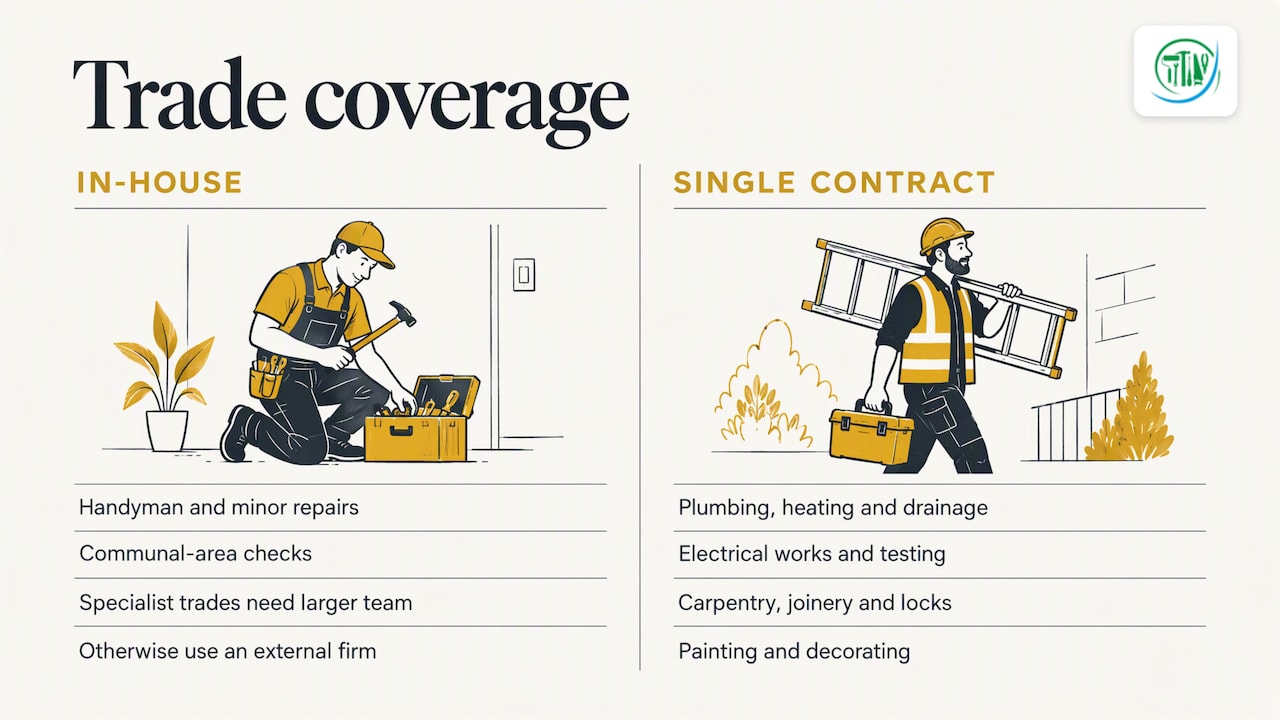
In-house teams usually do well at the first line of work: handyman tasks, minor repairs, making good, checking communal areas, and knowing the quirks of each building. Work involving specialist trades, such as electrical testing, roofing, heating and drainage, or masonry, often needs either a larger team or an external firm.
A contract that integrates all trades solves that in one step. Under our own contracts, for example, the trades sit under a single agreement: plumbing, heating and drainage, electrical works and testing, carpentry, joinery and locks, painting and decorating, roofing, guttering and external fabric, and bricklaying and masonry, alongside handyman work, communal areas, voids and refurbishment. The benefit is not only breadth but coordination: one party schedules the trades, so a repair that needs a joiner and then a decorator does not become two separate negotiations.
If you stay in-house, be honest about the skills you have. Work at height, electrical work and anything involving roofs needs competent people and the right equipment. The permit to work system is a good example of the discipline that has to sit around higher-risk tasks whichever model you choose.
Out-of-hours and emergency response
Buildings fail at night, at weekends and on bank holidays. A burst pipe in a block on a Saturday evening, a failed door lock in a retail unit or a roof leak during a storm will not wait for Monday.
An in-house team can respond quickly when someone is on site or nearby. The difficulty is sustaining it: a rota means paying for on-call cover, managing working-time and rest, and planning for the weeks when half the team is away. For a very small team, “out of hours” often means one person’s mobile.
Outsourced contracts can write response commitments into the agreement and back them with a wider pool of operatives. That is the sensible thing to test when you compare providers: what is committed, in writing, for emergencies and for routine reactive jobs, and how performance against those commitments is reported to you. Treat any promise that is not in the contract as a hope rather than a service level.
Compliance, safety and records
Compliance is where the choice between models is often decided, because the paperwork matters as much as the work.
With an in-house team, you hold the competence evidence, the risk assessments, the method statements, the training records and the insurance position. That is manageable for a few people, but it needs a named owner and regular review.
With an outsourced provider, you should expect the contractor to demonstrate competence through recognised schemes and to hand you clear records. When you check a contractor, look at accreditations such as SafeContractor and CHAS, and understand what they do and do not tell you; our guide to CHAS accreditation explains what clients should check. Vetting of operatives, including DBS checks where staff enter residents’ homes or sensitive premises, is another point to ask about.
Remedial work that follows an inspection also needs a route to completion. Inspections for areas such as electrical installations or fire safety are carried out by the relevant competent specialists, and the repairs they identify then need quoting, doing and evidencing. A contractor who handles compliance-related works as part of the same contract can close that loop without a separate procurement each time. Check the electrical maintenance checklist and the guide to commercial building condition surveys for the kind of information a planned programme should be built on.
Whichever model you choose, the evidence has to be easy to find. An auditor, insurer or tenant asking what was done, when and by whom should get an answer in minutes, not days.
Management time
This is the hidden cost on both sides.
In-house, you or a colleague become the employer and the line manager. That means recruitment, rotas, appraisals, grievance handling, training plans, vehicle and equipment maintenance, and supervising work you may not be expert in. For a facilities manager already stretched across several sites, that is a heavy load.
Outsourcing swaps that for contract management: setting scope, reviewing reports, challenging poor performance and approving works. It is lighter, but not zero. It works best when the contractor assigns a named contract manager to your portfolio, so there is one person who knows your buildings and answers for the results. Detailed monthly reporting then gives you something to review at a regular meeting rather than a stream of chasing emails.
The real saving for managing agents and housing associations is usually the reduction in the number of relationships. One contract, one manager and one monthly report replace several quotes, several invoices and several sets of paperwork.
The software question: CMMS, CAFM and IWMS
Many teams reading about this decision also search for the difference between maintenance software types, because the tool you use to run work orders affects both models.
The IWFM glossary defines the three terms: a CMMS is software for maintenance programmes and asset histories, CAFM supports a broad range of facilities management activities, and an IWMS is a platform for optimising workplace resources. In practice:
- CMMS is the narrowest. It centres on work orders, planned maintenance schedules and asset records for equipment.
- CAFM is broader, typically adding space, helpdesk and building-fabric information alongside maintenance. RICS guidance describes CAFM as an umbrella term for systems that hold detailed information about space, fabric and installed infrastructure to plan and control FM activity.
- IWMS is the widest, combining workplace, property, projects and sustainability in one platform, and is generally aimed at larger estates.
The boundaries are not strict. The same RICS note says that CAFM, IWMS and CMMS systems may all maintain asset registers, and that they are increasingly integrated with building-management systems.
What matters for the outsourced or in-house decision is who holds the data and how it is kept accurate. Poor integration can force teams to run systems separately and rely on manual processes, which FMJ notes takes time and introduces errors, particularly across multiple sites. If you run in-house, you are likely to buy and administer a system yourself, and that has a cost in set-up, training and data quality. If you outsource, ask what the contractor uses, what you can see, and in what format your records and monthly reporting reach you. For many portfolios, a clear reporting arrangement from the contractor is a far smaller step than commissioning a full platform.
Hybrid models
The choice is rarely all or nothing. Common hybrid patterns work like this:
| Model | What stays in-house | What goes to a contractor | Best suited to |
|---|---|---|---|
| Fully in-house | Everything, including supervision and records | Specialist one-offs only | Compact, stable portfolios with steady work |
| Fully outsourced | Contract management and approvals | All planned and reactive work | Dispersed or varied portfolios, lean teams |
| Hybrid: in-house core | Handyman tasks, site checks, first response | Specialist trades, roofing, electrical testing, peak and out-of-hours work | Mid-sized portfolios wanting local knowledge plus depth |
| Hybrid: contractor-led | Budget, strategy, tenant relations | Planned programme, reactive repairs, voids and refurbishment | Housing associations and agents with several blocks |
A hybrid works only if the boundary is clear. Decide which jobs belong to whom, how an in-house operative hands over to a contractor, and who owns the records. Without that, you get the costs of both models and the accountability of neither.
Duties that stay with you
Outsourcing moves the work, not the accountability. HSE’s guide to using contractors is aimed at employers who use contractors and covers how to identify the job, select a suitable contractor, assess the risks, provide information, manage and supervise the work, cooperate with the contractor and understand where responsibility lies. The shorter version is that both you and the contractor have responsibilities under health and safety law.
In practice that means you still need to:
- Choose a contractor who is competent for the work, and check the evidence rather than assuming it.
- Share the site information they need, such as access arrangements, known hazards and the layout of services.
- Cooperate and coordinate where your own staff, tenants or other contractors share the space.
- Keep a view of how the work is being managed and supervised.
- Retain your own responsibilities as the person in control of the premises, which sit with you regardless of who holds the spanner.
Where a specific legal duty or inspection interval applies to your building, such as for fire safety, electrical installations or water systems, take it from the relevant UK source and the competent specialist who assesses your premises, and agree in writing who is responsible for arranging, acting on and recording each item.
Pros and cons at a glance
| Factor | In-house | Outsourced |
|---|---|---|
| Cost | Fixed overheads; efficient when work is steady | Pay for the work done; clearer budgeting under a scoped contract |
| Skills | Strong on routine work; gaps in specialist trades | Wider trade cover under one contract |
| Out-of-hours | Depends on rota and team size | Can be written into the contract |
| Compliance records | You build and hold everything | Contractor supplies records; you review |
| Management time | High: you are the employer | Lower: you manage the contract |
| Control | Direct and immediate | Through the contract and the contract manager |
| Local knowledge | Deep, if staff stay | Depends on continuity of the assigned team |
Our perspective
We work with commercial properties, housing associations and managing agents across London, and the pattern we see is consistent: the problems rarely come from the choice between in-house and outsourced. They come from fragmentation. Several vendors, several sets of paperwork and no single person accountable are what turn a leaking roof into a tenant complaint.
That is why we built our service around integrating all trades under a single contract, with a dedicated contract manager for each portfolio, fixed response times written into the agreement and detailed monthly reports. Our operatives are DBS checked, and we work to SafeContractor and CHAS accreditations. Our aim is to give you the accountability of an in-house team without the employment overhead, and the breadth of a multi-trade contractor without the complexity of managing many of them.
Where an in-house team already works well, we are happy to see the arrangement as complementary: your people keep the day-to-day knowledge, and a contract covers the trades, peaks and out-of-hours demand that a small team cannot sustain.
— BW Building Maintenance
How a single contract works in practice
If you decide to outsource all or part of the work, our planned and reactive building maintenance service covers planned preventative maintenance, reactive and emergency repairs, handyman work, communal areas, plumbing, heating and drainage, electrical works and testing, carpentry, joinery and locks, painting and decorating, roofing, guttering and external fabric, bricklaying and masonry, voids and refurbishment, and compliance-related remedial works, all under one agreement.

For planned work, our guides to commercial roof maintenance and commercial plumbing maintenance show the sort of programme a preventative contract is built around.
How to decide
Work through these questions in order:
- How many buildings, and how far apart? Several sites across London favour outsourcing or a hybrid; one or two close sites can suit in-house.
- How varied is the work? If most jobs need one or two skills, in-house can be efficient. If you need many trades, a single contract is simpler.
- What happens at 2 a.m. on a Sunday? If you cannot staff a rota sustainably, write out-of-hours cover into a contract.
- Who owns the records? Decide where inspection evidence, certificates and repair histories live, and make sure they are accessible to you.
- How much management time do you have? Be honest about what employing a team would take from your week.
- What do your budget holders need? Service charge budgets and board reports reward predictability and clear reporting.
If your answers point both ways, start with a hybrid and review it after a year of reporting data.
FAQ
Is outsourcing building maintenance cheaper than in-house?
Not automatically. In-house can be cheaper when work is steady and one or two skills cover most jobs. Outsourcing often wins when demand is uneven, several trades are needed or you would otherwise carry cover, vehicles, training and management time. Compare the full cost of each, not just wages against invoices.
Can I outsource my legal responsibilities for the building?
No. You can hand the work to a contractor, but you still have to choose a competent one, share relevant information and cooperate with them, as HSE’s guidance on using contractors explains. Responsibility for the premises stays with you.
What is the difference between CMMS and CAFM?
A CMMS focuses on maintenance: work orders, schedules and asset histories. CAFM is broader and typically adds space and wider facilities information. The two overlap, and many systems blur the line, so check what you need to record before you choose.
Is a hybrid model worth considering?
Yes, particularly for mid-sized portfolios. A small in-house team can handle routine checks and first response while a contractor covers specialist trades and out-of-hours work. Define who does what and who owns the records, or the arrangement loses its benefit.
Sources
- HSE: Using contractors, a brief guide (INDG368)
- IWFM glossary
- RICS Strategic FM Framework guidance note
- FMJ: CAFM considerations