Commercial Building Condition Surveys: What They Cover

A commercial building condition survey is a systematic, mostly visual inspection of a property’s structure, fabric, external areas and, where instructed, its services. It ends with a written report that rates each element’s condition, ranks defects by priority and puts costs against the work. For a London facilities manager or managing agent, its real value is what it lets you do next: replace guesswork with a costed programme of works over five to ten years.
This guide explains what surveyors look at, how condition and priority ratings work, how often to revisit a survey, and how to turn the findings into a maintenance plan you can defend to an owner or put into a service charge budget.
TL;DR
- A condition survey records the state of the structure, roof, external envelope, internal finishes and (if instructed) mechanical and electrical services, then rates and prices what it finds.
- Condition ratings describe the state of an element today. Priority ratings describe how urgent the fix is. You need both.
- There is no single legal interval for a condition survey. Refresh it when the building changes, when defects appear, and on a review cycle you set from risk.
- The most useful output is a planned preventative maintenance (PPM) schedule, ideally a spreadsheet you can rework as budgets change.
- A survey only pays back once the works are scheduled, assigned and reported on. Without that, it is a report in a drawer.
Table of Contents
- What a commercial condition survey is, and what to call it
- What surveyors actually inspect
- Condition ratings and priority ratings
- How often should you commission a condition survey?
- From survey findings to a 5 to 10 year plan
- A worked example of turning findings into a programme
- Choosing who does the survey, and who does the work
- Our perspective: a survey is a starting line
- Putting the schedule into practice
- FAQ
- Sources
What a commercial condition survey is, and what to call it
Terminology causes confusion before the survey even starts. In the RICS guidance, the RICS standard on technical due diligence of commercial property says the industry generally uses the term technical due diligence (TDD). Building survey, building condition inspection, pre-acquisition survey and vendor survey are also used. The same guidance says the term “structural survey” should not be used, because the work is a balanced professional opinion on the technical condition of the asset, not a structural engineer’s analysis.
The guidance describes TDD as the systematic review, analysis and gathering of information about a property’s physical characteristics. It identifies four points in a building’s life where it is typically used: acquisition (including financing and refinancing), occupation and operation, disposal and refurbishment or development.
For people who manage buildings rather than trade them, the second category matters most. A condition survey during occupation tells you what you hold, what is wearing out and what it will cost to keep the building safe and lettable.
It also helps to separate three documents that get mixed up:
| Document | Main purpose | Typical output |
|---|---|---|
| Condition survey | Record the current state of the building | Ratings, defects, photographs |
| PPM survey or schedule | Plan maintenance and renewal over a set period | Costed schedule by year |
| Schedule of condition | Record condition at a point in time, often for a lease | Descriptive record with photographs |
The RICS guidance on planned preventative maintenance defines a condition survey as a standalone assessment of the physical state of a building, and treats the PPM schedule as the document that turns it into a forward plan. Many clients commission both together as an integrated condition survey and costed PPM, which is what you want if your goal is budgeting.
What surveyors actually inspect
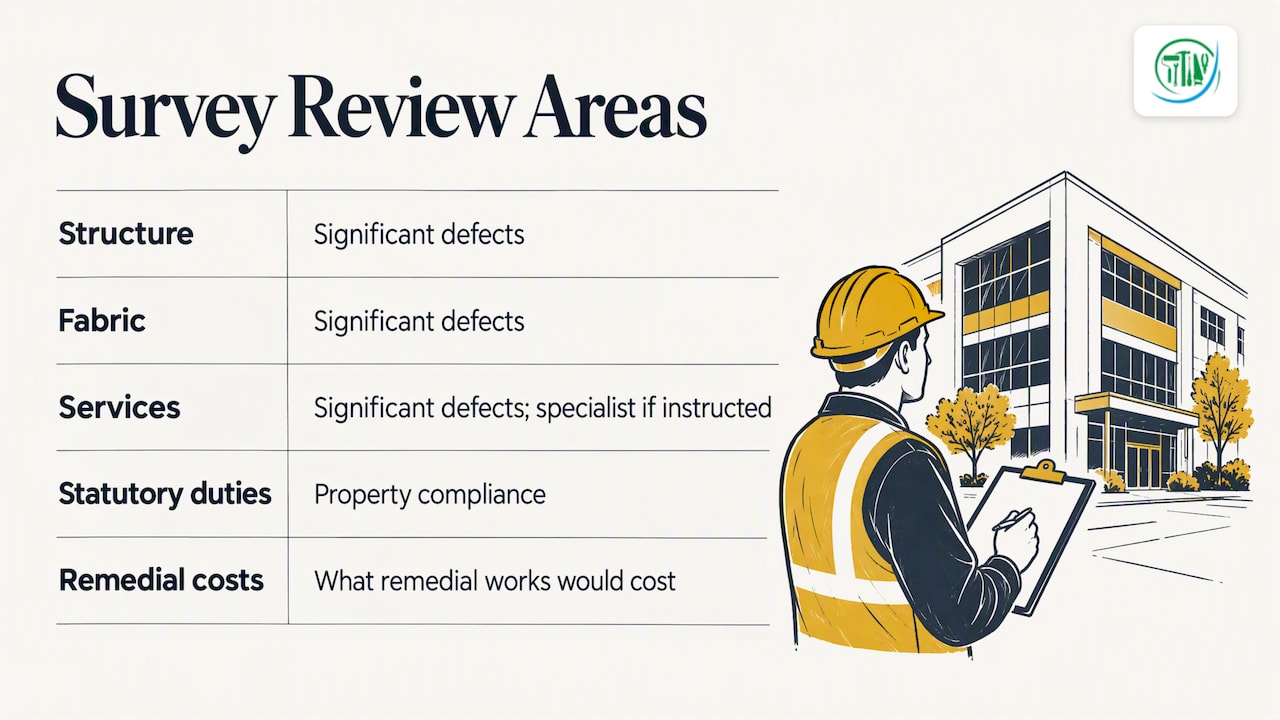
The RICS due diligence guidance explains that a TDD exercise looks for significant defects in the structure, fabric and services installations, with the services element undertaken by a specialist if instructed. It also considers whether the property complies with statutory obligations and what remedial works would cost. In practice, a commercial survey works through the building element by element.
Structure and external fabric
The surveyor looks at the frame, floors and load-bearing walls for signs of movement, cracking, deflection or deterioration. Externally, they check roofs, rainwater goods, facades, brickwork and pointing, cladding, windows, external doors and any balconies or walkways. Visual inspection is the norm, so access matters: if a flat roof, plant deck or high-level elevation cannot be reached safely, the report should say what was not inspected.
This is where many London buildings reveal the cost of deferred work. Failed pointing, blocked gutters and worn roof coverings let water in, and water causes most of the secondary damage inside. If roofs are a concern across your portfolio, our note on commercial roof maintenance for property managers sets out a practical inspection routine.
Internal areas
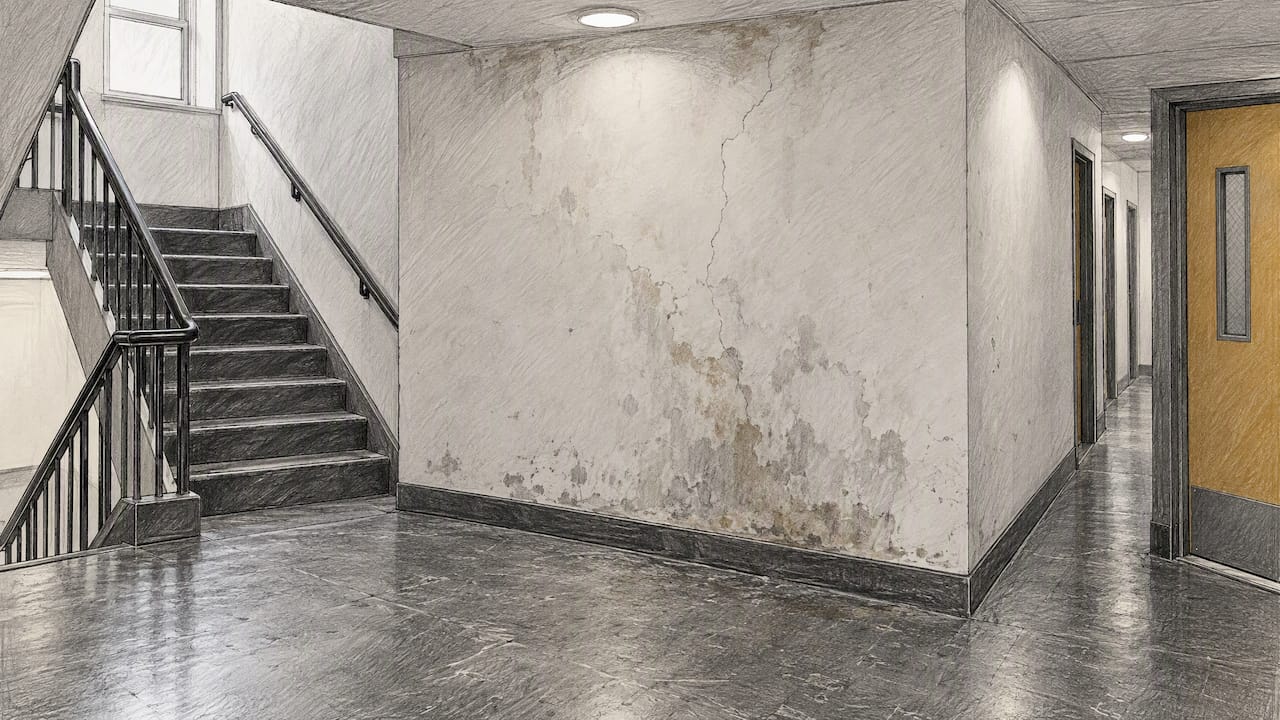
Internally the survey covers floors, walls, ceilings, staircases, joinery, ironmongery, fixed finishes and communal areas such as lobbies, corridors and stair cores. Surveyors note damp staining, cracking, worn finishes, failed seals and anything that points to a hidden fault.
Services
Mechanical and electrical services are often scoped separately. A general building surveyor can note the visible condition and age of boilers, pipework, distribution boards and lighting. A detailed assessment of capacity, performance or compliance usually needs a specialist engineer, and the RICS guidance anticipates that division. Agree in writing which services are in and which are out.
For plumbing and drainage in particular, an age and condition note on pipework and tanks feeds directly into your reactive-repair risk. Our piece on commercial plumbing maintenance intervals explains what regular checks catch early.
External areas and site
Car parks, boundary walls, drainage runs, external lighting, paving and landscaping fall within a typical scope. These are often forgotten in budgets until a trip claim or a flooding incident forces the issue.
Regulatory and safety observations
A condition survey is not a compliance audit, but a good surveyor will flag visible matters that may have statutory implications. Under the Regulatory Reform (Fire Safety) Order 2005, the responsible person must ensure that safety equipment and systems are subject to a suitable maintenance regime and kept in an efficient state. The survey will not replace your fire risk assessment, but it should tell you whether fire doors, escape routes and compartmentation look intact, and whether anything needs a specialist follow-up.
The RICS PPM guidance also lists the materials that tend to need specialist attention, such as asbestos-containing materials and aluminium composite material cladding. If the survey suggests either might be present, treat that as a trigger to instruct the right specialist, not something to resolve from the general report.
Using drone imagery where access is difficult
Roofs, parapets and tall elevations are the hardest areas to inspect safely and cheaply. Aerial imagery can supplement a surveyor’s visit by giving a clear record of areas that are awkward to reach. This guide to drone inspection reports and photo checks for UK property owners explains what to look for in the images. Treat photographs as evidence that supports the surveyor’s findings, not a substitute for a competent inspection.
Condition ratings and priority ratings
A well-built report separates two questions: what state is this element in, and how soon do you need to act?
Condition ratings
The RICS PPM guidance suggests rating each element, sub-element or component on a simple scale. Its four categories run as follows:
- Good: in good condition with no outstanding repair or maintenance needs, although cyclical work such as decoration may apply.
- Fair: serviceable and acceptable, but showing age-related wear, weathering or superficial damage. Repair or renewal may be needed.
- Poor: reaching the end of its designed or intended service life, or excessively weathered or damaged. Repair or renewal will be needed within the period the schedule covers.
- Hazardous: dangerous, with imminent works needed to fix the problem or to comply with health and safety or other statutory requirements.
The RICS draft guidance note on planned preventative maintenance sets these out, and you will see variations in individual surveyors’ reports. What matters is that the definitions are written down at the front of the report, so that two people reading it reach the same view.
Priority and risk ratings
The same guidance says surveyors should assess the risk a defect poses and the consequence of leaving it untreated. There is no mandatory format, but it gives example codes: 1 urgent, 2 essential, 3 desirable, 4 cyclical and 5 statutory. Observations are often colour coded.
The distinction is practical. A roof covering can be in poor condition but low priority because it has several years of life left and is not leaking. A cracked fire door leaf may be only fair in general condition, yet urgent because of what it protects. If you only receive one rating, ask for the other.
Reading costs with care
Costs in a first-pass report are budget estimates, and surveyors often lean towards cautious figures when information is limited. The RICS draft PPM guidance notes that estimates can be refined as you move from the initial survey to a developed schedule of works, provided the method behind any revision is documented. Ask for that audit trail. When an owner asks why the figure for a roof dropped between versions, you want a written answer.
How often should you commission a condition survey?
There is no single legal interval for commissioning a commercial condition survey, and we will not invent one. What the sources do support is a risk-based approach.
- The RICS PPM guidance says PPM surveys must be reviewed and updated at frequent intervals to stay effective. It does not fix one number for every building.
- The HSE guidance on inspection of work equipment explains that the purpose of an inspection is to find deterioration and put it right before it becomes a risk. Equipment inspection is not the same as a building survey, but the principle carries over: frequency should follow risk and history.
- The HSE guidance on maintenance of work equipment is clear that maintenance should be planned, carried out by suitably competent people, and supplemented with outside expertise where in-house knowledge falls short.
In practice, these are sensible triggers for a fresh survey or a formal update:
- A change of ownership, financing or lease event. Acquisition, refinancing, disposal and lease events are the points at which TDD is most often commissioned.
- A new or renewed maintenance contract. A baseline helps you set scope and measure what changes.
- Visible deterioration. Recurring leaks, cracking, failed finishes or a rise in reactive call-outs suggest your last picture is out of date.
- Major works or change of use. Refurbishment and fit-out alter loads, services and risk.
- The end of the schedule’s review period. Whatever interval you and your surveyor agreed, put the date in the diary.
Long periods with negligible wear can justify longer intervals, and signs of deterioration can justify shorter ones. Record your reasoning, because it is your evidence of a considered approach.
From survey findings to a 5 to 10 year plan
The RICS PPM guidance says surveys of this type are generally prepared to cover maintenance periods of 5 to 10 years, though they can extend further. A report that only lists defects does not give you that. You need a schedule.
Step 1: Insist on a structured format
The most useful format is a PPM schedule as a spreadsheet. It lets you adjust costs and test scenarios, which matters when you are building a service charge budget. The RICS guidance also points to standardised element lists such as NRM 3 so that data can be compared across a portfolio. The RICS Construction Journal on NRM 3 notes it is widely used for condition surveying of existing estates, with typical surveys working at element and sub-element level to keep costs reasonable.
Step 2: Sort works into bands
Take the priority codes and group the actions:
- Immediate (urgent and hazardous): safety-critical and water ingress items. Instruct these now through your reactive route.
- Near term: essential works to be planned, procured and programmed in the next budget cycle.
- Medium and long term: renewals tied to the end of an element’s economic life, such as roof coverings, boilers and windows.
- Cyclical: redecoration, gutter clearance, sealant renewal and similar repeating tasks.
- Statutory: works that arise from regulation, which need a named legal or technical source before you fix a deadline.
Step 3: Assign years and costs
Place each action in a year, with a cost and a note of the assumption behind it. Smooth the peaks where you can. Two major roof renewals in the same year are rarely sensible if one can safely wait, but only move an item if the condition rating supports it.
Step 4: Separate what the survey excludes
A long-term condition report typically leaves out day-to-day items like cleaning or minor security, which sit in shorter-term facilities contracts. They still belong in your overall budget. The RICS Service Charge Code, now in its sixth iteration, is the industry reference for how service charges are managed and administered, so check your plan against it before it reaches tenants.
Step 5: Build it into the golden thread
For higher-risk buildings in England, the Building Safety Act 2022 puts weight on keeping accurate, accessible building information. A BSI white paper on health and safety information in digital form discusses structuring risk information, with reference to ISO 19650-6, so you can track mitigations across the asset life cycle. Whether or not your building falls within the higher-risk category, a survey schedule held as structured data is easier to keep current than a PDF.
Step 6: Review on a schedule
Put a review date against the plan. Each time works are completed, update the rating. Each time a new defect appears, add it. A schedule that is not maintained decays as fast as the building does.
A worked example of turning findings into a programme
Take a hypothetical three-storey mixed-use block with retail at ground level and offices above. The survey finds the following, using the RICS example codes. These are illustrative, not drawn from any real building or client.
| Element | Condition | Priority | Action in the plan |
|---|---|---|---|
| Flat roof covering | Poor | 2, essential | Plan renewal in the next budget cycle, with interim repairs to stop leaks |
| Rear fire door | Fair | 1, urgent | Repair or replace now, then record completion |
| Rainwater goods | Fair | 4, cyclical | Add to a repeating clearance programme |
| Stair core decoration | Fair | 3, desirable | Schedule with the next communal redecoration |
| Boundary wall pointing | Poor | 2, essential | Repoint in the medium term, monitor for movement |
| Main distribution board | Poor | 5, statutory | Refer to a qualified electrical engineer for testing and advice |
Notice what the table does. It turns a long report into a short action list that a managing agent can put in front of an owner, with a logical order of work. It also shows that condition and priority are separate columns that sometimes disagree.
Choosing who does the survey, and who does the work
A condition survey should be impartial. The RICS guidance asks its members to give an impartial professional opinion, and many owners prefer that the party carrying out the inspection is separate from the party quoting for the repairs. That is sensible. Commission the survey from a suitably qualified surveyor, check the scope and the exclusions, and ask what professional indemnity cover they hold, since the RICS guidance lists this among the items to confirm when instructing.
When you commission, agree these points in writing:
- The elements and areas in scope, and those excluded.
- Whether services are inspected, and by whom.
- Access arrangements for roofs, plant rooms and tenanted space.
- The rating system and its definitions.
- Whether you want a costed PPM schedule, the period it covers and the file format.
- Photographic referencing for each defect.
Our perspective: a survey is a starting line
We maintain commercial buildings in London, so we see what happens after the report lands. The pattern we notice is that surveys fail at the handover, not at the inspection. The findings are sound, but the works sit across several trades, with different contractors, different timescales and nobody holding the whole list.
That is why we run planned and reactive maintenance as one contract, with all trades under one roof and a named contract manager for each portfolio. A survey schedule naturally maps onto that structure: the roofing items, the electrical items, the joinery and the decoration all sit in one programme, with one point of accountability and monthly reporting on what has been done and what is outstanding.
Our advice to managing agents is simple. Keep reactive repairs and planned work in the same picture, because every reactive call-out is information about the survey. If the same element keeps failing, its rating was probably too generous. Feed that back, and update the schedule.
And be wary of long lists with no sequence. Ten urgent items, none of them ranked, will stall a budget meeting. A short list, ordered by risk and tied to a year, gets signed off.
— BW Building Maintenance
Putting the schedule into practice
Once the survey is done and the plan is agreed, you need a contractor capable of delivering planned preventative maintenance, reactive repairs and the trades behind them under one agreement. We provide that across London, from roofing, guttering and external fabric to plumbing, heating and drainage, electrical works and testing, carpentry and joinery, painting and decorating, bricklaying and masonry, voids and refurbishment and compliance-related remedial works. Our operatives are DBS-checked and we hold SafeContractor and CHAS accreditation. You can see the full range on our building maintenance London page.
Two practical points when handing a survey to a contractor. First, share the full report, not just the summary, so that the works are scoped against the actual findings. Second, where works involve hazardous tasks such as roof access or isolation of services, agree how they will be controlled. Our explainer on the permit to work system in building maintenance shows how that works day to day. Roof work is also subject to the Work at Height Regulations 2005, so the access method should be settled before anyone goes up.
FAQ
Is a commercial condition survey the same as a structural survey?
No. The RICS guidance on technical due diligence says the term structural survey should not be used. A condition survey is a balanced professional opinion on the technical condition of the building, covering structure, fabric and external areas, and services where instructed. If you suspect a specific structural problem, a structural engineer should investigate it separately.
Who should commission the survey, the landlord or the managing agent?
Either can, depending on the lease and the management agreement. What matters is who is responsible for the building and who funds the work. If costs will be recovered through the service charge, check the lease and the RICS Service Charge Code before instructing, and tell the owner what the survey will cover.
How long does a condition survey stay valid?
There is no fixed shelf life. The RICS guidance says PPM surveys must be reviewed and updated at frequent intervals, and HSE guidance on inspection links frequency to risk and deterioration. Treat the survey as live: update ratings when works are done, when defects appear, and at an agreed review date.
Does a condition survey cover fire safety, asbestos and legionella?
Not as a full assessment. A surveyor may note visible issues and recommend specialist follow-up, but fire risk assessments, asbestos surveys and water hygiene assessments are separate pieces of work for suitably qualified people. Make sure your survey scope says what is excluded so nothing is assumed to be covered.
What should I do with the report once I have it?
Sort the findings into urgent, near-term, medium-term, cyclical and statutory bands, assign each to a year with a cost, and put the schedule into a spreadsheet you can adjust. Then hand the works to a contractor that can deliver them under one programme, and set a review date.
Sources
- RICS: Technical due diligence of commercial property
- Regulatory Reform (Fire Safety) Order 2005, article 17
- RICS draft guidance note: Planned preventative maintenance
- HSE: Inspection of work equipment
- HSE: Maintenance of work equipment
- RICS Construction Journal: NRM 3 and asset life cycle data
- RICS: Service charges in commercial property
- BSI white paper on health and safety information in digital form