PAT Testing Frequency: How Often Does Equipment Need It?
There is no fixed legal interval for PAT testing in the UK. The law requires you to keep electrical equipment in a safe condition, and it leaves you to decide how, and how often, by looking at the equipment, the people who use it and the place it sits in. For a London office, shop or block, that usually means a mix of user checks, formal visual inspections and, where the risk justifies it, combined inspection and testing, each on its own interval, with the reasoning written down.
This guide is for facilities managers, managing agents, landlords and housing associations who need a schedule they can defend, not a calendar habit inherited from the last contractor.
TL;DR
- No law says portable appliances must be tested every year. The duty is to maintain equipment so it does not cause injury, and the frequency follows risk.
- HSE’s suggested starting points for low-risk environments run from 6 months to 4 years for visual inspections and 1 to 5 years for combined inspection and testing, depending on the equipment.
- Hand-held and frequently moved items, such as extension leads, need checking far more often than a monitor on a desk that never moves.
- Shorten intervals when faults turn up, lengthen them only when your records show consistent safety, and write down why.
- Keep an equipment register, inspection and test records and a defect log, because they are what shows a risk-based schedule is real.
Table of Contents
- What the law actually says about PAT testing
- What decides how often equipment should be checked
- Three layers of checking, not one
- Suggested starting intervals
- Offices, shops and communal areas
- Retesting after damage, repair, relocation or a change in use
- Keeping the records that make the schedule defensible
- Perspective: why a frequency chart is not a maintenance plan
- How we support the maintenance side
- A practical way to build your schedule
- FAQ
- Sources
What the law actually says about PAT testing
PAT stands for portable appliance testing, and the phrase appears nowhere in the legislation as a duty. What exists is the Electricity at Work Regulations 1989. Under them, employers must maintain electrical equipment that has the potential to cause injury, but HSE’s guidance on maintaining portable electrical equipment is clear that the regulations do not say exactly how, or how often, this must be done.
The common belief that appliances must be tested annually is a myth. HSE’s PAT testing FAQs address it directly: there is no legal requirement for annual testing, and the frequency of inspection and testing depends on the type of equipment and the environment it is used in.
Two practical consequences follow for anyone who manages a building.
- Testing is one tool, not the obligation. HSE points out that simple user checks and visual inspections are often enough for many kinds of equipment, and that formal PAT should sit inside a wider safety regime, not be the whole of it.
- You carry the burden of justification. Because the law names no interval, whatever you choose has to be explainable. If an incident occurs, the question is whether your approach was reasonable for the risk, and a documented risk assessment is how you show that.
Where a fixed interval does appear
There is one notable exception to the “no fixed interval” rule, and it concerns residential landlords. In England, the Electrical Safety Standards in the Private Rented Sector (Amendment) Regulations 2025 require social landlords to ensure in-service inspection and testing of the electrical equipment they provide at least every five years, as set out in the regulations on legislation.gov.uk. If you manage homes for a housing association, read that instrument for its scope and wording. It is a rule for that sector in England, not a general commercial rule, and it does not stop you from inspecting more often where risk calls for it.
What decides how often equipment should be checked
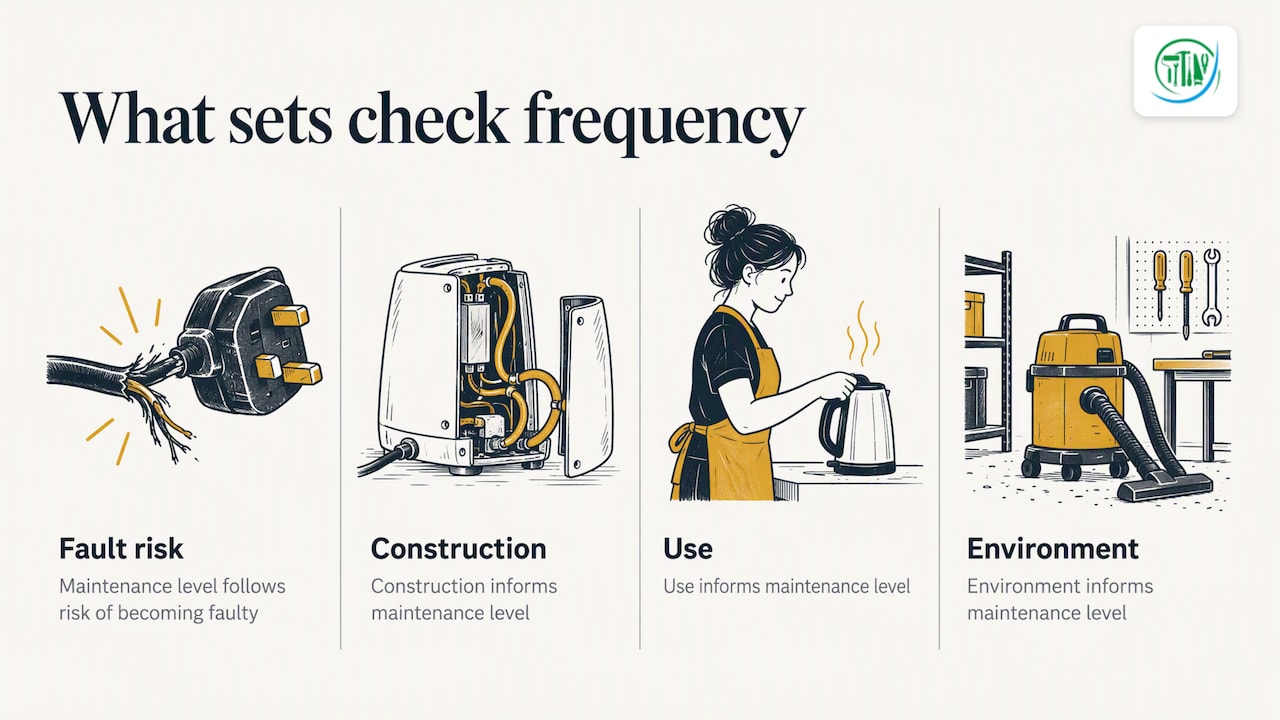
HSE’s approach is to set the level of maintenance according to the risk of an item becoming faulty, how it is constructed, and how it is used and the environment it is in. Broken down, four questions do most of the work.
How is the equipment built?
Class matters. Equipment that is double insulated carries a lower risk of a dangerous fault reaching the user than equipment that relies on an earth connection, and HSE lists construction, including double insulation, among the things to weigh. A double-insulated lamp and an earthed kettle do not need the same treatment.
Is it hand-held or moved around?
Items that people grip, carry, plug and unplug take more punishment. Cables get pulled, plugs get dropped, and connections work loose. Extension leads, portable heaters, vacuum cleaners and power tools sit at the demanding end. A printer that stays on the same shelf for years sits at the other.
Who uses it?
Equipment used by many people, or by the public, is more likely to be misused and less likely to have its faults reported. A kettle in a staff kitchen used by 40 people across several tenancies is a different risk from a desk lamp used by one person who would notice a frayed flex.
Where is it used?
Harsh or wet environments increase risk, as do places where equipment is regularly moved or knocked about. The University of Reading’s Safety Code of Practice 12 lists these same factors as reasons for more frequent checks. A plant room, a cleaner’s store, a loading bay and a commercial kitchen all belong in that category.
Three layers of checking, not one
HSE’s guidance describes a maintenance strategy that combines three things, and the frequency question is really three separate frequency questions.
| Layer | Who does it | What it involves | Typical rhythm |
|---|---|---|---|
| User check | Anyone using the item | Looking at the cable, plug and casing before use, and reporting anything wrong | Every time the item is used |
| Formal visual inspection | A trained or competent person, usually someone on site | A structured look at plugs, flexes, casings and signs of overheating or damage, recorded against the item | Set by risk, from months to a few years |
| Combined inspection and test | A competent person with a suitable tester | Visual inspection plus electrical tests, recorded with a result | Set by risk, typically longer than visual checks |
The point of the layers is that they catch different faults at different speeds. A user check finds a cracked plug the day it happens. A formal visual inspection finds the worn flex nobody reported. A test finds faults you cannot see, such as a deteriorating earth connection or damaged insulation inside the casing.
Because most faults in portable equipment are visible damage, a sensible schedule leans on the first two layers and reserves testing for the items and places where it earns its place. That is why HSE can say that formal PAT should be part of the regime, not all of it.
Suggested starting intervals
For low-risk environments, HSE suggests initial intervals of 6 months to 4 years for visual inspections, and 1 to 5 years for combined inspection and testing, depending on the type of equipment. These are starting points. HSE’s own wording treats them as something you adjust once you see what your inspections find.
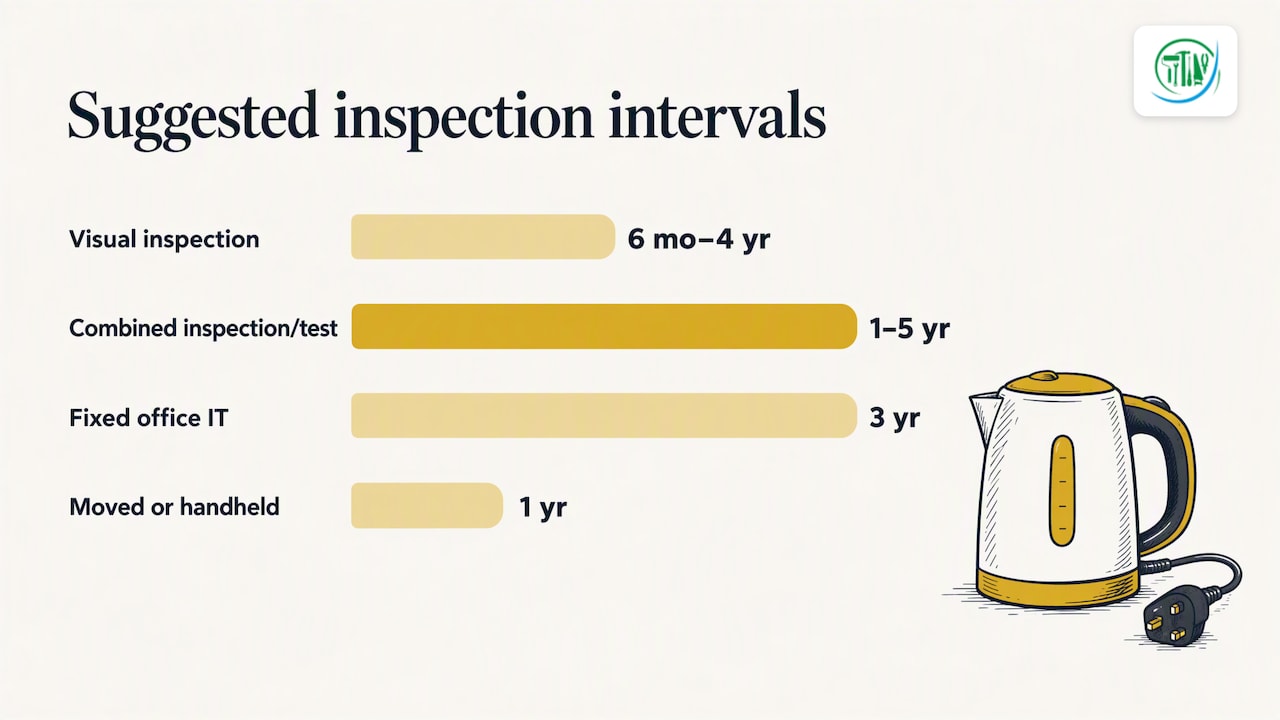
The Reading code gives a useful worked example from a large organisation. Office equipment that stays in one place, such as IT equipment, generally needs an in-service test every 3 years there, while frequently moved or hand-held items such as extension leads are checked annually. That university also requires risk assessment, prior test results and failure data, and sign-off from its health and safety team before it accepts longer intervals. Treat it as an illustration of how one cautious organisation applies the principle, not as a legal standard.
Here is how that logic translates into the kinds of equipment you meet in managed buildings. The right-hand column describes direction, not a statutory figure.
| Equipment | Risk profile | Direction for your schedule |
|---|---|---|
| Desktop computers, monitors, fixed printers | Low, stationary, double insulated or low power | Longest intervals; visual inspection often carries most of the load |
| Extension leads and multi-socket adaptors | Higher, flexes are pulled and moved | Shorter intervals, with user checks every use |
| Kettles, toasters, microwaves in shared kitchens | Higher, heat, many users, spills | Shorter intervals than the same item in a private office |
| Portable heaters and fans | Higher, moved seasonally, run for long periods | Check before each season of use and at a short interval thereafter |
| Vacuum cleaners and floor machines used by cleaners | Higher, dragged, cables run over | Short intervals, and cleaners trained to report damage |
| Power tools used by maintenance staff or contractors | High, hand-held, site conditions | Short intervals, with a check before each job |
| Equipment in wet, dusty or outdoor areas | High, harsh environment | Short intervals, with justification recorded |
Higher-risk settings such as construction sites, commercial kitchens and care homes call for shorter intervals and an explicit note in the maintenance record explaining why. If a building mixes uses, for example offices above a restaurant, do not apply one interval across the whole property.
Grouping equipment
It is tempting to test everything in a building in one visit. If you group items that way, the Reading code advises applying the shortest interval in the group to every item in it. That is simple and safe, but it can mean over-testing low-risk items. Splitting the register into two or three risk bands is usually more efficient than one blanket interval.
Offices, shops and communal areas
The three settings below are where London property teams ask the question most often, so it helps to be specific.
Offices
Most office equipment is stationary, low-risk and used by one person. That puts it at the long end of the range: formal visual inspections at moderate intervals, testing at the longer intervals HSE suggests for low-risk environments, and user checks as the daily safeguard. The exceptions are extension leads, adaptors, kitchen appliances and anything staff bring in from home, which belong in a shorter-interval band. If tenants supply their own equipment, agree in the lease or occupier handbook who is responsible for it. Landlord-owned items in shared areas are yours to schedule.
Shops and retail units
Retail adds public contact and a lot of temporary equipment: display lighting, till and card equipment, floor cleaners, stockroom lighting on leads. Staff turnover means user checks only work if every new starter is shown what to look for. Items near the public, or in back-of-house areas where cables run across floors, deserve shorter intervals. Seasonal fittings such as Christmas lighting are a good case for a visual check before they go up.
Communal areas and blocks
Portable equipment in communal areas is often overlooked because nobody owns it day to day. Think of cleaners’ vacuums and polishers, portable heaters in a concierge desk, extension leads in a plant room, power tools left by contractors and kettles in a staff room. In a block, these items are used by several people across several organisations, which pushes towards shorter intervals and clear ownership in your register. Where social landlords provide electrical equipment to residents, remember the five-year in-service inspection and testing rule for England described above.
Fixed installations are a separate matter. Portable appliance checks do not cover the building’s fixed wiring, which is dealt with through its own inspection regime, so keep the two schedules distinct in your planner.
Retesting after damage, repair, relocation or a change in use
The calendar is not the only trigger. Whatever interval you set, some events should prompt an immediate check by a competent person before the item goes back into use.
- Damage. A cracked casing, crushed cable, burn marks or a plug that has been dropped heavily. Take the item out of use at once and label it so nobody plugs it back in.
- Repair. Equipment that has been opened up or had a flex or plug replaced should be checked before it returns to service, and the result recorded.
- Relocation. Moving an item from a quiet office to a plant room or loading bay changes its environment. Re-band it in your register and apply the interval for its new setting.
- Change of use. An item lent to contractors, used outdoors or used by more people than before has moved up the risk scale.
- A fault found elsewhere. If several items of the same type fail, shorten the interval for that whole type.
This is practical judgement drawn from the duty to maintain equipment safely, and your risk assessment should say what triggers an out-of-cycle check in your building. Where the fault points to a wider electrical problem, such as repeated tripping or scorching at a socket, involve a qualified electrician instead of treating it as a portable appliance matter.
Keeping the records that make the schedule defensible
A risk-based approach is only as good as its paper trail. A workable set has three parts:
- An equipment register: what each item is, where it lives, who owns it, its risk band and its next check.
- Inspection and test records: dates, who checked, what was found and the result.
- A defect log: faults reported by users or found in inspections, and what was done.
The defect log is what lets you change intervals with confidence. HSE describes a risk-based system as dynamic: shorten intervals if inspections find faults, and lengthen them only if records show consistent safety. Write the reasoning next to the change, so the next manager inherits the logic and not just the date.
The same discipline applies to other building systems. Door entry and key-control equipment, for instance, benefit from similar logs, and this guide to access control maintenance shows how documentation supports a planned approach to upkeep. Where work on a building involves contractors using their own equipment, a permit to work system is a useful place to check that equipment is fit for use before work starts.
HSE’s FAQs also address whether you must label tested items and keep records. Labelling can help the person doing the next check, but records are what matter. A sticker with no register behind it proves little.
Perspective: why a frequency chart is not a maintenance plan
We look after commercial buildings in London under planned and reactive contracts, and the pattern we see is the same across portfolios: electrical safety fails less often because of a missed test date than because nobody owns the small stuff. The extension lead taped to a skirting board, the heater that appeared in the winter and stayed, the kettle in a shared kitchen that three tenants assume belongs to someone else.
So our view is that frequency is the second question. The first is ownership. Decide who is responsible for each class of equipment, give it a place in the register, and make reporting a damaged item easy for the people who spot it first. Then choose intervals by risk, review them against what your inspections find, and keep the reasoning on file.
We would also resist the idea that more testing is always safer. Over-testing low-risk equipment spends budget that would do more good on the high-risk items and on fixing what inspections turn up. Under a single contract, one named contract manager can see defects, repairs and recurring faults in the same monthly report, which is exactly the information a risk-based schedule needs.
— BW Building Maintenance
How we support the maintenance side
When an inspection finds a faulty socket, damaged flex or worn fitting, someone has to put it right and record that it was done. Our planned and reactive building maintenance for London commercial properties brings electrical works and testing, plumbing, carpentry, roofing and the other trades under one contract, with a dedicated contract manager and monthly reporting for each portfolio, so remedial work and your records stay in one place.

If you are also reviewing other maintenance cycles across a building, our guides on commercial building condition surveys and commercial roof maintenance cover how planned inspection works for other parts of the building.
A practical way to build your schedule
If you are starting from nothing, or inheriting a schedule nobody can explain, work through these steps.
- Walk the building and list every portable item, including tenant-supplied equipment in shared areas and anything contractors leave behind.
- Assign an owner to each item or class of item.
- Band by risk using construction, how it is handled, who uses it and where. Two or three bands are enough.
- Set starting intervals for each layer within the ranges HSE suggests for low-risk environments, and shorter where the environment is harsher. Record why.
- Train the people who use the equipment to look before they plug in and to report damage.
- Log every defect and review the log at least when you renew or retender contracts, and sooner if a cluster appears.
- Adjust. Shorten where faults appear, lengthen only where the records support it.
FAQ
How often should I PAT test in the UK?
There is no set legal frequency. HSE’s guidance suggests starting intervals of 6 months to 4 years for visual inspections and 1 to 5 years for combined inspection and testing in low-risk environments, then adjusting according to what your inspections find. Higher-risk items and settings need shorter intervals.
Is PAT testing a legal requirement?
Not directly. The Electricity at Work Regulations 1989 require you to maintain electrical equipment that could cause injury, but they do not name PAT testing or an interval. Testing is one way of meeting that duty, and for some equipment a user check or visual inspection is enough.
Do I need to test new equipment?
HSE’s FAQs cover this question, and the sensible starting point is a visual check of new items when they arrive and an entry in your register so their first scheduled check is planned. Read the HSE answer for the position on new equipment before you decide how to treat items in your own building.
Does a qualified electrician have to carry out PAT testing?
Not necessarily. HSE says that what matters is that the person doing the inspection or test is competent, with the right training, knowledge and equipment for the task. Complex faults or anything involving fixed wiring should go to a qualified electrician.
Can I extend my PAT testing interval?
Yes, if your records justify it. HSE describes risk-based maintenance as dynamic: intervals may be lengthened where records show consistent safety, and should be shortened where faults are found. Note the evidence and the decision in your register.
Sources
- HSE: PAT (portable appliance testing), HSE’s answers to popular questions
- HSE: Maintaining portable electrical equipment in low-risk environments
- The Electrical Safety Standards in the Private Rented Sector (England) (Amendment) Regulations 2025
- University of Reading: Safety Code of Practice 12, Portable Appliance Testing