Commercial Plumbing Maintenance: 5 Intervals That Catch Leaks Early
A reliable commercial plumbing maintenance programme combines routine inspections, leak detection and submetering, a documented asset register, and a baseline schedule of monthly visual checks, quarterly drain reviews, and an annual professional inspection with any backflow devices tested on the schedule your water company sets. Leaks alone can account for more than 6% of a facility’s total water use, according to the US EPA’s WaterSense programme, which is why monitoring should be a core maintenance task, not an afterthought.
TL;DR:
Staff should inspect accessible pipework each shift, log defects with location, severity, and isolation status, then check fixtures and clean aerators weekly.
Fit submeters on major systems and use temporary flow meters for spot checks; route alerts to more than one person and write responsibility into your maintenance agreement.
Backflow devices such as RPZ valves need your water company’s consent before installation, then a test by an approved tester at commissioning and typically once a year after that.
Persistent slow drains, blockages, grease build-up, or odours after basic cleaning warrant a CCTV drain survey and professional service, rather than repeated quick fixes.
An annual dye test in each toilet cistern exposes slow leaks that routine visual checks miss but water bills can reveal.
Table of Contents
-
What to inspect in drains, fixtures, heaters, pumps, and backflow devices
-
Scheduling backflow tests and keeping compliance records straight
-
Why an integrated maintenance contract keeps this programme on track
-
How we help you run this programme without juggling contractors
Building a frequency-based maintenance checklist
A commercial plumbing system fails in predictable stages. Small defects go unnoticed, water use creeps up, and a fixture or line finally gives out during business hours. A checklist organised by frequency catches problems while they are still cheap to fix.
Daily or per-shift tasks keep the baseline visible: walk accessible pipework, valves, fixtures, and plant rooms for moisture, staining, unusual sound, or odour, and review any abnormal water-use readings from the previous day. Staff should record defects with location, severity, and isolation status so nothing gets lost between shifts.
Weekly tasks go a layer deeper. Inspect taps, toilets, and sensor-operated fixtures, clean aerators to maintain flow and pressure, and check the valves and drains that are easy to reach without shutting down a system.
Monthly tasks bring in measurement. WaterSense at Work, the US EPA’s guide for commercial buildings, recommends visual pipe inspections for corrosion and staining, regular submeter readings, floor-by-floor water pressure checks, and a scan for fixtures that run continuously without anyone noticing.
Quarterly tasks address the parts of the system that clog or wear gradually: drain cleaning, grease trap service, CCTV drain surveys of higher-risk lines, and exercising shut-off valves so they do not seize when an emergency isolation is needed.
Annual tasks close the loop. Water heaters and boilers need professional servicing, backflow devices such as RPZ valves need testing by an approved tester when your water company says it is due, and the full asset register and O&M contract deserve a complete review rather than a quick glance.
-
Daily: visual leak checks, odour and sound checks, defect logging
-
Weekly: fixture inspection, aerator cleaning, visible valve and drain checks
-
Monthly: pipe inspection, submeter readings, pressure testing, running-fixture checks
-
Quarterly: drain cleaning, grease trap service, CCTV drain survey, valve exercising
-
Annual: water heater and boiler service, backflow testing, asset register review
Pro Tip: Assign a single owner to each frequency tier so quarterly and annual tasks do not quietly slip when daily fires take priority.
What to inspect in drains, fixtures, heaters, pumps, and backflow devices
Each system tells you something different when it is drifting out of range, and knowing what to watch for turns a routine walk-through into an early warning system.
Drain and sewer lines show stress through slow flow, recurring blockages, grease build-up, or a foul odour near floor drains. When any of these persist after a basic cleaning, that is the signal to escalate to a CCTV drain survey and professional service rather than repeating the same quick fix.
Sanitary fixtures hide two common failures: toilets that run continuously and flush valves that drift out of their timing range. US EPA guidance recommends an annual dye test for toilets with cisterns to catch slow leaks that are invisible to the eye but show up on the water bill.
Water heaters and boilers need flushing to clear sediment, along with inspection of tubes and steam lines during an annual service. Water quality considerations also belong in that annual review, since temperature and stagnation both affect system performance and safety.
Pumps and valves matter most in an emergency, which is exactly when nobody wants to be hunting for a stopcock. Map every isolation point in advance, exercise valves on a schedule, and log each test in the asset register so the next technician knows which ones actually work.
Backflow devices need their own inventory: installation consents, test reports, and the testing schedule your water company has set, since it decides when each device’s next test is due.
-
Drains: watch for slow flow, blockages, grease, and odour
-
Fixtures: dye-test toilets annually, check flush valve timing
-
Heaters and boilers: flush sediment, inspect tubes and steam lines annually
-
Pumps and valves: map isolation points, exercise and log valve operation
-
Backflow devices: list every device, track consents and test dates
Turning submeters and leak alerts into maintenance signals
Water-use data is a maintenance tool, not just a billing number. A spike that shows up on a submeter often means a leak or a running fixture long before anyone notices a wet floor or hears a complaint.
WaterSense at Work recommends installing submeters on major systems and using temporary flow meters for spot checks on equipment that does not justify a permanent meter. Leak alerts work best when they route to more than one person, and that routing should be written into the operations and maintenance agreement rather than left informal.
Leaks can account for more than 6% of a facility’s total water use, a share large enough that catching it early changes both the water bill and the odds of an unplanned outage.
Water-quality controls belong in the same programme. In the UK, managing water temperature, circulation, and stagnation to control legionella is covered by HSE’s Approved Code of Practice L8, and pairing efficiency work with quality controls avoids fixing one problem while creating another.
-
Install submeters on major systems and spot-check the rest
-
Route leak alerts to more than one responsible person
-
Write leak detection into the O&M contract, not just the maintenance log
-
Train staff and post signage so occupants report issues faster
Scheduling backflow tests and keeping compliance records straight
In the UK, backflow protection falls under the Water Supply (Water Fittings) Regulations 1999, and your water company (Thames Water across much of London) sets the testing schedule for higher-risk devices such as RPZ valves. Water Regs UK guidance explains that RPZ valves are tested at commissioning and then whenever the water company says a test is due, typically once a year. Only an approved tester can carry out the test, so book it before the due date and keep a copy of every report.
Legionella risk management belongs in the same programme. HSE’s Approved Code of Practice L8 expects duty holders to carry out a risk assessment, appoint a responsible person, and keep records of inspections and control measures, reviewing them regularly rather than treating it as a one-off assessment.
-
Confirm backflow test due dates with your water company directly
-
Assign a named person responsible for legionella risk documentation
-
Keep test certificates, approvals, and close-out records in the asset register
Why an integrated maintenance contract keeps this programme on track
A checklist only works if someone is accountable for running it. An integrated planned and reactive maintenance contract centralises reporting, sets fixed response times, and assigns a dedicated contract manager, so inspection records, compliance documents, and contractor status reports stay in one place instead of scattered across multiple trades. Before requesting a contract review, gather your asset register along with existing meter readings and compliance test records.
What the checklist gets wrong if you stop at the paperwork
The biggest mistake we see in commercial plumbing programmes is treating the checklist as the finish line rather than the starting point. A completed monthly inspection form means nothing if nobody acts on what it reveals, and a lot of facilities teams mistake documentation for prevention.
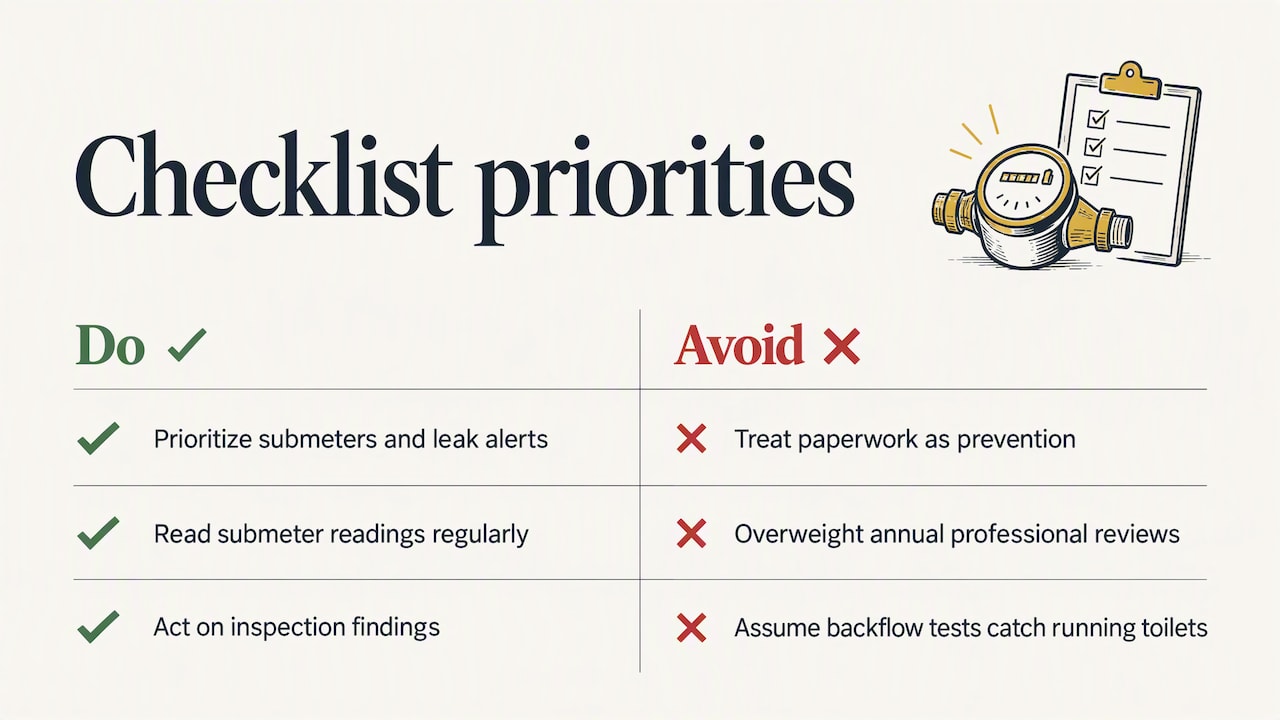
The conventional advice tends to overweight the annual professional review and underweight the daily and weekly tasks that catch problems while they are still minor. Backflow testing must follow your water company’s schedule, but it will not catch a running toilet that wastes water before anyone notices the bill.
If you take one thing from this guide, prioritise the monitoring layer first: submeters, leak alerts, and a habit of actually reading the readings. Everything else, from drain cleaning schedules to boiler servicing, works better when you already know where water is going.
— Montgomery
How we help you run this programme without juggling contractors
We bring planned and reactive building maintenance, including plumbing, heating, and drainage services, under one contract, so the checklist above becomes a scheduled, reported reality rather than a document in a drawer. Scheduled inspections, monthly reporting, and a named contract manager mean the same person tracks your asset register and your compliance deadlines.

To scope a programme, we need your current asset register, recent meter readings, and any existing compliance certificates such as backflow test reports. If you want a maintenance review or a sample schedule built around your building, visit our maintenance services page to get started.
FAQ
How often should commercial plumbing systems be inspected?
A reasonable baseline is monthly visual inspections, quarterly drain and valve checks, and an annual professional review covering water heaters, boilers, and backflow assemblies. Your water company may set a different schedule for backflow devices such as RPZ valves, so confirm the exact due dates with them.
What is the biggest cause of wasted water in commercial buildings?
Leaks are a leading contributor, and the US EPA’s WaterSense programme states leaks can account for more than 6% of a facility’s total water use. Submetering and routine leak checks are the most direct way to catch this early.
Who sets backflow testing requirements for commercial properties?
In the UK, your water company enforces the Water Supply (Water Fittings) Regulations 1999 and decides when backflow devices such as RPZ valves must be tested, typically once a year. Tests must be carried out by an approved tester, and your own water company’s requirements govern your building.
What should a commercial plumbing asset register include?
It should document every major fixture and system, planned task frequencies, emergency isolation points, and compliance records such as test certificates and installation approvals. A complete register makes it clear who inspected each asset, what was found, and when it will be reviewed again.
Does BW Building Maintenance handle plumbing as part of a wider contract?
Yes, plumbing, heating, and drainage services are included under our planned and reactive maintenance contracts, alongside other trades, scheduled inspections, and monthly reporting through a dedicated contract manager.