CHAS Accreditation Explained: What Clients Should Check
CHAS accreditation is a third-party health and safety assessment of a contractor. It is run by Veriforce CHAS, the Contractors Health and Safety Assessment Scheme, and it is one of the schemes buyers use to pre-qualify suppliers. It tells you a contractor has had its health and safety arrangements reviewed by someone independent. It does not tell you the contractor can do your job, at your building, safely. This guide explains what CHAS checks, how the three membership levels differ, how CHAS relates to SSIP, and how to verify a contractor before you appoint them in London.
TL;DR
- CHAS is a health and safety pre-qualification scheme and a member of SSIP (Safety Schemes in Procurement). It is evidence of capability, not proof of it.
- There are three CHAS levels: Standard, Advanced and Elite. Ask which one was assessed, and match it to your own procurement requirements rather than defaulting to the highest.
- HSE says schemes like this are one way to show competence and are not required by law.
- Verify the legal entity, the package, the current status and the scope, then add job-specific checks such as method statements, references and site controls.
Table of Contents
- What CHAS is and what it checks
- The three CHAS membership levels
- How CHAS relates to SSIP
- Is CHAS a legal requirement?
- How to verify a contractor’s CHAS status
- What CHAS does not tell you
- Our perspective on accreditation and maintenance contracts
- Building the check into your appointment process
- Maintenance contracts across all trades
- FAQ
- Sources
What CHAS is and what it checks
CHAS is a supply chain assessment scheme that grew up in construction and the public sector. Contractors upload evidence, and CHAS assesses it. According to CHAS’s own membership guidance, that evidence includes policies, inspection records, insurance information and training or certification records.
In practice, a health and safety assessment looks at whether a business has the management arrangements you would expect from a competent employer. That means a written policy, risk assessment practice, competent advice, training, accident reporting and insurance. CHAS assesses against the SSIP core criteria, which HSE describes as reflecting compliance with basic health and safety law.
Two points follow from that:
- The assessment is about the organisation’s systems. It is a snapshot of how a company manages health and safety in general.
- It is not an inspection of the work on your site. Your risks, such as roof access above a occupied retail unit, electrical isolation in a plant room or working in a block with vulnerable residents, sit outside what a general assessment can judge.
That is why HSE’s position matters to anyone buying maintenance. Accreditation cuts duplication in pre-qualification, but the question that matters most is still whether this supplier can safely carry out this particular work at this particular site.
The three CHAS membership levels
CHAS packages its assessments into three tiers. The full detail is on the CHAS membership levels page, and the summary below follows CHAS’s published descriptions.
| Level | What CHAS says it covers | Typical buyer need |
|---|---|---|
| Standard | A health and safety assessment, a self-certified insurance module and SSIP compliance | Core health and safety pre-qualification |
| Advanced | Builds on SSIP and the former PAS 91 approach, with 10 risk-management areas and extra modules such as modern slavery, financial responsibility and environmental standards | Buyers wanting broader organisational information |
| Elite | Includes the Common Assessment Standard, a construction pre-qualification system covering 13 risk-management areas | Public-sector or construction supply-chain buyers who need the widest coverage |
Standard
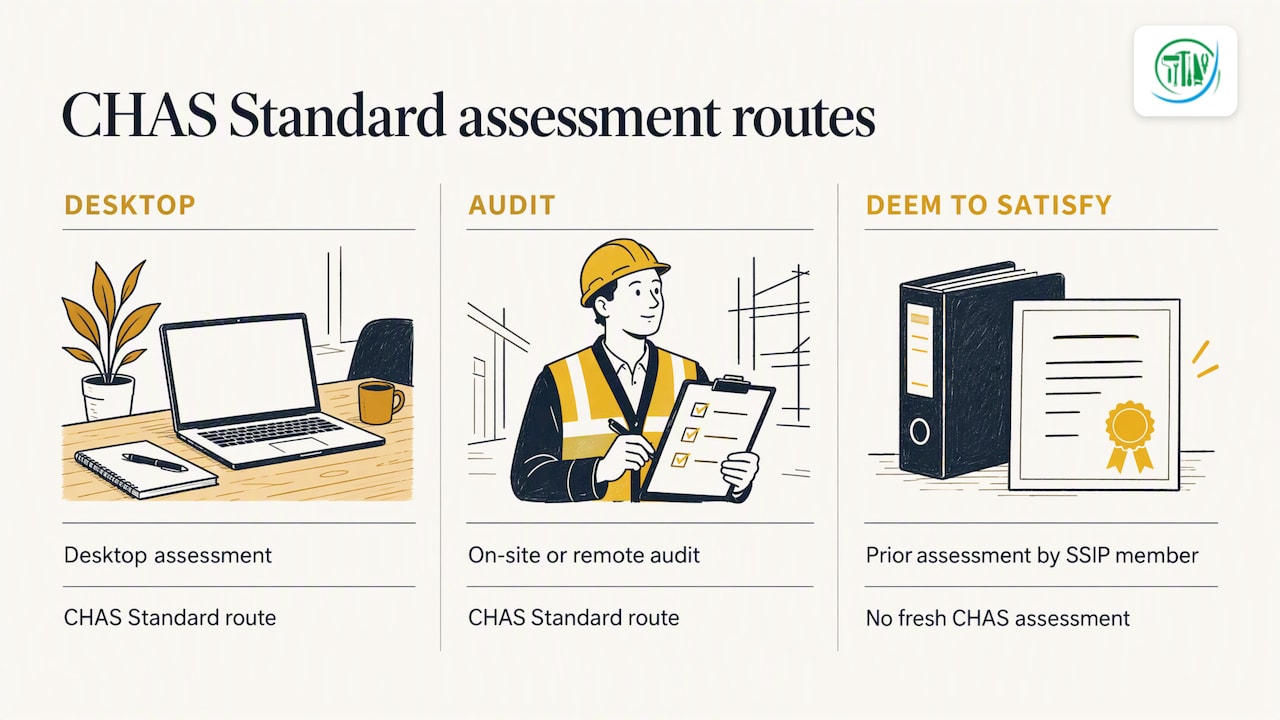
CHAS Standard is the entry-level package. CHAS describes three routes to assessment: a desktop assessment, an on-site or remote audit, and SSIP Deem to Satisfy, which is for contractors already assessed by another SSIP member scheme. A contractor that arrives through Deem to Satisfy has not been re-assessed from scratch by CHAS, so it is reasonable to ask which route applies if it matters to your governance file.
Advanced
CHAS Advanced is the middle package. CHAS says it covers the core modules of the former PAS 91 pre-qualification standard and SSIP. Note the word “former”: if a tender document still asks for PAS 91, state in your procurement documents exactly what you now require, and do not assume an Advanced assessment automatically answers every buyer’s questionnaire.
Elite
Elite is the broadest level and includes the Common Assessment Standard. It is aimed at buyers who need wider supply-chain information, often in public-sector or larger construction settings. It is not automatically the right answer for a managing agent buying planned and reactive maintenance across a portfolio of commercial buildings. The right level is the one your procurement framework, lender, insurer or client specifies, not the highest one on the shelf.
Also remember that a label does not establish competence for every maintenance task. An Elite contractor can still be the wrong choice for specialist roofing, and a Standard contractor can be entirely adequate for routine handyman and decorating work.
How CHAS relates to SSIP
SSIP, Safety Schemes in Procurement, is the umbrella forum that sets a common health and safety baseline across many assessment schemes. CHAS is a member scheme, and Veriforce CHAS describes itself as a co-founder of SSIP and of the Common Assessment Standard.
Why this matters for you as a buyer:
- Mutual recognition. HSE explains that, because SSIP member schemes recognise one another, buyers should not normally demand several SSIP assessments for the same health and safety elements. If a contractor holds another SSIP member scheme’s certificate, asking them to buy a CHAS one as well adds cost to your supply chain without adding assurance.
- Same baseline, different extras. The core criteria are shared. What differs between schemes is the additional modules, the platform and the way records are shared.
- Project-specific checks remain necessary. HSE is explicit that the SSIP core criteria describe basic legal compliance. They do not replace checks on the work in question.
This is also the short answer to the question of CHAS against other schemes such as SafeContractor or Constructionline. They are different schemes with different features, and there is no single winner. For health and safety, what matters is that the scheme is an SSIP member and that the assessed scope matches your work. Procurement-focused registers sometimes add financial and wider supplier-data checks, so read what each scheme actually covers before you write one into a specification.
Is CHAS a legal requirement?
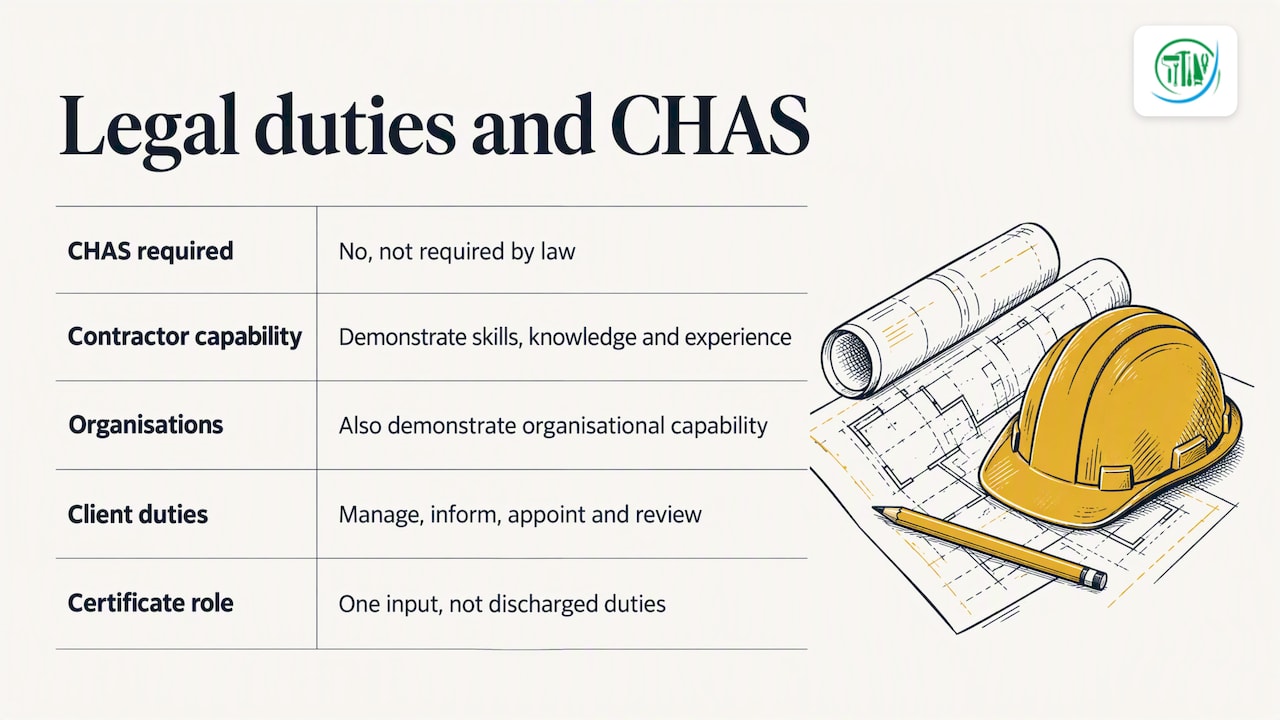
No. HSE states that conformity assessment schemes are one way to demonstrate capability and that they are not required by law. A contractor without CHAS is not breaking any rule, and a client who insists on it is making a commercial choice.
What the law does require is that you appoint people who are capable. Under the Construction (Design and Management) Regulations 2015, HSE says a contractor must be able to demonstrate the skills, knowledge and experience, and, where it is an organisation, the organisational capability, to carry out the work safely. Evidence can include training records, professional memberships, references and a suitable third-party assessment. CHAS can be the third-party assessment. It rarely does the whole job alone.
The duties sit with you too. For work that falls under CDM 2015, HSE’s guidance for commercial clients says clients must make suitable management arrangements, provide relevant pre-construction information, appoint capable dutyholders where required, and maintain and review the arrangements. The regulations themselves, in Part 2 of CDM 2015, set out the client’s duty to make suitable arrangements so that work can be carried out, so far as is reasonably practicable, without risks to anyone affected. Treat a CHAS certificate as one input to that governance file. It is not evidence that your own duties have been discharged.
How to verify a contractor’s CHAS status
A logo on a website or an undated PDF is not verification. Work through these checks and record the result.
- Ask which package was assessed. Standard, Advanced and Elite cover different ground. Confirm that the level matches what your tender or framework states.
- Check the legal entity. The assessed company must be the one that will sign your contract and employ or control the operatives. A group logo can sit over several companies with different assessments.
- Confirm the status is current. CHAS says Standard supports annual audit arrangements, so an old certificate may not reflect today’s position. Check the live record rather than relying on a date-less document.
- Match the scope to the work. Ask whether the assessment reflects the trades you are commissioning, for example work at height, electrical work or work in occupied residential blocks.
- Ask how they got there. Desktop assessment, audit or Deem to Satisfy through another SSIP scheme are all legitimate, and each tells you something slightly different.
- Check insurance separately. Standard includes a self-certified insurance module. Self-certified means the contractor has declared its cover. Ask to see the policy schedule and confirm limits and expiry dates yourself.
- Add job-specific evidence. Request method statements and risk assessments for your site, competence records for the operatives, relevant trade registrations and references from comparable buildings.
Verification habits carry across sectors. Online marketplaces in other fields, such as a New Zealand platform for booking security guards that verifies guard profiles and licensing, show the same principle: check the individual and the credentials, not just the brand name.
What CHAS does not tell you
The gap between a certificate and a safe job is where most disputes start. A CHAS record does not tell you:
- Whether the contractor has the right trade competence for your plant, roof or electrical installation.
- How the contractor will control access, isolation, hot work or work at height on your site. In a building with active tenants, a permit to work system is often the control that makes the difference.
- How reliably the contractor reports, escalates and closes out defects.
- Whether supervision and subcontractor management will hold up when jobs multiply across a portfolio.
HSE frames CDM 2015 around choosing the right team and enabling safe cooperation, not producing paperwork for its own sake. A CHAS check is most useful when it feeds into mobilisation, information sharing and ongoing monitoring.
Our perspective on accreditation and maintenance contracts
We work with managing agents, landlords and housing associations who look after commercial buildings in London, and we see the same pattern in procurement. Accreditation questions get asked at tender and then rarely revisited. The certificate goes in a folder, and the real management of risk becomes whatever happens when a roof leak or a failed boiler arrives at 4pm on a Friday.
Our view is that accreditation is the start of the conversation. A buyer gets far more from asking how a contractor manages work day to day: who is accountable, how information is reported and how many separate vendors you have to coordinate. When plumbing, electrical, roofing and decorating sit with different firms, each with its own paperwork and its own assessment status, you carry the verification burden many times over. We built our service around a single contract covering all trades, a named contract manager for each portfolio and detailed monthly reporting, so that accountability has one address. Our operatives are DBS-checked, and we encourage clients to ask every contractor, us included, for the evidence behind any claim rather than relying on a logo.
If you are writing a specification, say precisely what you want to see: the scheme, the level, the legal entity and the date. Then ask for the job-specific controls that no scheme can supply.
— BW Building Maintenance
Building the check into your appointment process
A sensible, proportionate process for a London managing agent or facilities team looks like this:
- Set the requirement in the tender. Name the accepted SSIP schemes and say whether you want a particular CHAS level. HSE’s point about mutual recognition means you should accept equivalent SSIP assessments rather than insisting on one brand.
- Scale the assessment to the risk. A contractor repainting a communal corridor presents a different risk profile from one re-covering a flat roof. HSE’s capability test applies to both, but the evidence you ask for should be proportionate.
- Keep a record. Note the scheme, level, entity, date checked and who checked it. Revisit it at renewal and when the scope of the contract changes.
- Monitor in operation. Use reporting, site inspections and incident review to confirm that what was assessed on paper matches what happens on site.
Maintenance contracts across all trades
If you manage commercial buildings and are tired of coordinating separate vendors for each trade, we provide planned preventative maintenance and reactive repairs under one contract, covering plumbing, heating and drainage, electrical works and testing, carpentry, joinery and locks, painting and decorating, roofing, guttering and external fabric, bricklaying and masonry, voids and refurbishment, communal areas and compliance-related remedial works. Each portfolio has a named contract manager and monthly reporting. See the details on the BW Building Maintenance site, or read our maintenance blog for more on managing contractor risk.
FAQ
What does CHAS accreditation mean?
It means a contractor has had its health and safety arrangements assessed by Veriforce CHAS, an SSIP member scheme. The assessment reviews evidence such as policies, inspection records, insurance and training. It shows a baseline of organisational competence, not suitability for a specific job.
Do I have to use a CHAS-accredited contractor?
No. HSE says conformity assessment schemes are not required by law. You must still appoint contractors with the skills, knowledge, experience and organisational capability for the work, and CHAS is one way of evidencing part of that.
Is CHAS Elite better than Standard or Advanced?
It is broader, not automatically better for you. Elite includes the Common Assessment Standard across 13 risk-management areas, while Standard focuses on core health and safety and SSIP compliance. Choose the level your procurement requirements specify and test competence for the actual trade.
Do I need CHAS and another SSIP scheme certificate?
Usually not. SSIP member schemes recognise each other, and HSE says buyers should not normally demand multiple SSIP assessments for the same health and safety elements. Ask for one recognised SSIP certificate and check the scope and currency.
How do I check that a CHAS certificate is genuine?
Do not rely on a logo or undated PDF. Ask which package was assessed, confirm the legal entity and current status against CHAS’s own records, and compare the scope with the work you are commissioning.
Sources
- CHAS membership levels (Veriforce CHAS)
- How to become a CHAS member (Veriforce CHAS)
- CHAS Standard: contractor health and safety assessment (Veriforce CHAS)
- CHAS Advanced (Veriforce CHAS)
- Health and safety conformity assessment schemes (HSE)
- Are you a contractor? (HSE)
- Commercial clients: roles and responsibilities (HSE)
- The Construction (Design and Management) Regulations 2015, Part 2 (legislation.gov.uk)