Section 20 Consultation: A Step-by-Step Guide for Landlords
Section 20 consultation is the statutory process a landlord must follow before charging leaseholders for major works or a long-term agreement through the service charge. Get it right and you can recover the full cost through the service charge. Get it wrong and, unless a tribunal rescues you, your recovery from each leaseholder can be capped at a small fixed sum. This guide walks London landlords, managing agents and facilities managers through when it applies, each stage and notice, how to handle observations and estimates, when to seek dispensation, and where the process usually goes wrong. For a leaseholder-facing view, see the Leasehold Advisory Service guide to section 20 consultation.
TL;DR
- Consultation is required under section 20 of the Landlord and Tenant Act 1985 for qualifying works costing any one leaseholder more than £250, and for qualifying long-term agreements costing any one leaseholder more than £100 a year.
- The usual route is a notice of intention, then a statement of estimates, then a notice of reasons where you do not choose the lowest estimate or a leaseholder’s nominee. Each notice stage gives leaseholders 30 days to respond.
- Skip or botch the process and your recovery is limited to those thresholds unless the First-tier Tribunal grants dispensation.
- Leaseholders agreeing with the works does not remove the duty to consult.
- Specific descriptions of work, provable service and a clear audit trail prevent most disputes.
Table of Contents
- When section 20 consultation applies
- The stages and notices, step by step
- Handling observations and estimates
- What happens if you do not consult properly
- Dispensation: when the tribunal can excuse a failure
- Common mistakes that cap what you recover
- Planning the work around consultation
- How a single maintenance contract helps
- A practical timeline checklist
- FAQ
- Sources
When section 20 consultation applies
Section 20 limits what you can recover from leaseholders through variable service charges unless you have consulted. The duty sits in section 20 of the Landlord and Tenant Act 1985 and applies in England and Wales. It is triggered by two things.
Qualifying works. These are works to the building or premises where the contribution of any one leaseholder would be more than £250, including VAT, according to the Leasehold Advisory Service (LEASE). The test is per leaseholder, not the total job. A roof renewal on a block of twelve flats that costs each flat a few thousand pounds clears it easily, but so can a modest repair on a small block.
Qualifying long-term agreements (QLTAs). These are agreements that run for more than 12 months, where any one leaseholder would pay more than £100 a year. The 12-month element comes from the Act itself, and the £100 figure is given in the LEASE guidance. For a facilities manager this matters because a multi-year planned maintenance contract for a block can be a QLTA even when no single visit is expensive.

Why the thresholds catch smaller jobs than you expect
LEASE has pointed out that the thresholds have not been updated for over 20 years, so the process is often triggered by relatively minor works. That creates admin and delay for both sides. It does not change your duty. If a job might cross the line once costs are split across all leaseholders, plan for consultation from the start rather than discovering it halfway through.
What to check before you start
Consultation protects leaseholders paying variable service charges. Before drafting anything:
- Confirm who must be consulted: every leaseholder who will contribute, and any recognised tenants’ association.
- Read the lease to see what you can recharge, and how notices must be served.
- Estimate the per-leaseholder cost properly, using each leaseholder’s share, not the headline figure.
- Decide whether the work is a one-off or part of a longer agreement, since that changes the procedure.
If you manage mixed-use buildings, remember that commercial occupiers on fixed rents or non-variable charges are not the group this process protects. The residential leaseholders are.
The stages and notices, step by step
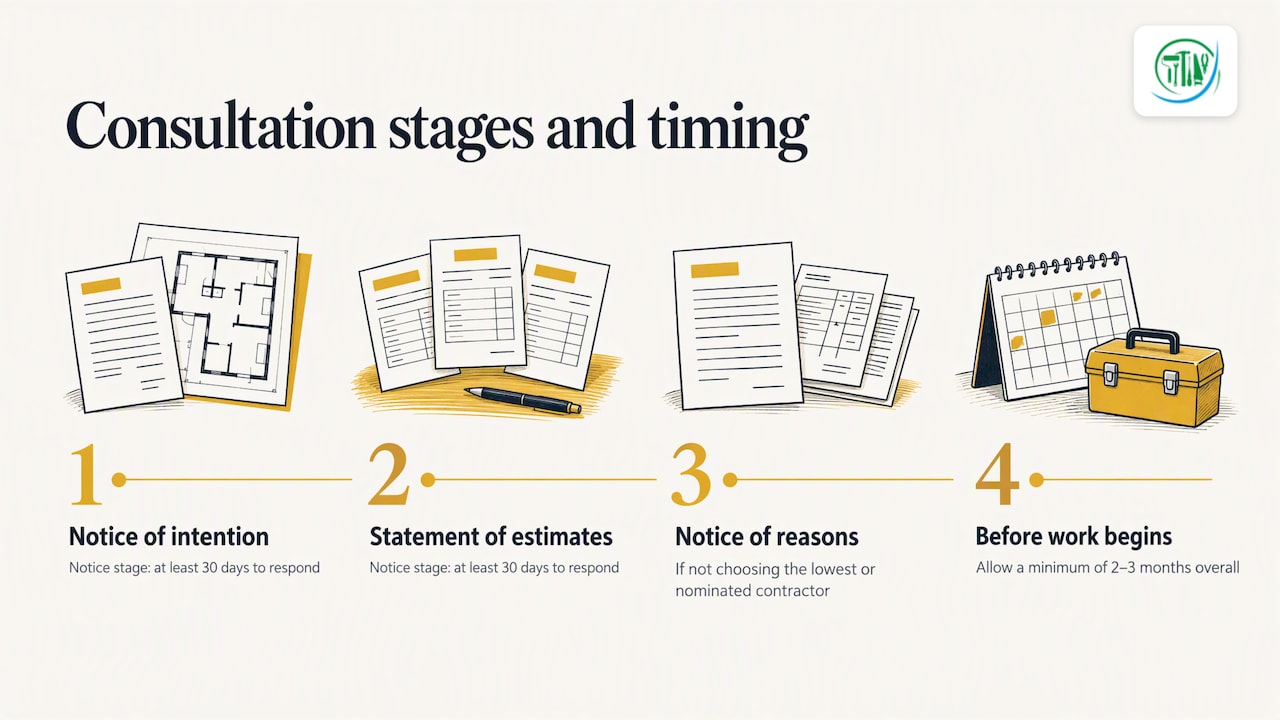
For qualifying works, the process typically has three stages: a notice of intention, a statement of estimates, and a notice of reasons if you do not select the lowest estimate or a contractor nominated by a leaseholder, as summarised in LEASE’s guidance on major works. Each stage involving a notice generally gives leaseholders at least 30 days to respond. Allow a realistic minimum of two to three months for the whole sequence before any work begins.
Stage 1: notice of intention
You serve a notice on every leaseholder describing the works and explaining why they are needed. Leaseholders then have 30 days to make observations and to nominate a contractor. If a leaseholder nominates someone, you must try to obtain an estimate from that contractor.
Good stage 1 notices:
- describe the works specifically, by location and type of work, not with catch-all wording;
- give the reasons the works are needed, ideally backed by a survey or inspection report;
- state where and how observations should be sent, and the date by which they must arrive.
If the notice is vague, you invite disputes later when the final work looks different from what was described. LEASE flags vague, catch-all phrasing as a recurring pitfall. A recent condition survey gives you a defensible description and reason for the work, and makes the scope far harder to challenge.
Stage 2: statement of estimates
Once the 30 days have passed and you have considered what leaseholders said, you obtain estimates. In the right-to-manage context described by LEASE, you must provide at least two estimates, and you must summarise leaseholders’ observations from stage 1 and respond to them. You do not have to follow the observations, but you must have regard to them. Check the lease and the regulations that apply to your landlord type, as the detail differs between landlords and RTM companies.
Leaseholders then have 30 days to comment on the estimates. Make the estimates available to inspect if you do not send them in full, for instance at the managing agent’s office.
Stage 3: notice of reasons
If you award the contract to someone other than the lowest estimate or a leaseholder’s nominee, you must explain why. This is the notice of reasons. Treat it as a decision record: state the criteria you applied, such as scope compliance, programme, accreditations and experience, so the choice reads as reasoned rather than arbitrary.
Qualifying long-term agreements
The QLTA procedure follows the same logic with differently named documents, notably a notice of proposals in place of estimates at the second stage. Because the rules vary with the type of agreement, and some agreements involve public notice requirements, check the Act and take legal advice before committing to a long contract.
Handling observations and estimates
The consultation is only useful if it is real. Leaseholders’ observations should change something or be answered with a reason.
Log everything. Keep a register of each observation: who sent it, when, what it said, and your response. You will rely on it if a challenge reaches the tribunal.
Answer by substance. Summarise the points made at stage 1 and say what you did about each. Silence on a reasonable point is the quickest route to a finding that leaseholders lost an opportunity to influence the works.
Take nominations seriously. If a leaseholder nominates a contractor, you must try to get an estimate from them. Document the attempt, including any refusal or non-response.
Keep estimates comparable. Issue the same scope to every contractor, including provisional sums and exclusions. Estimates that cannot be compared undermine the whole exercise.
Allow extra time for the post. Although the law provides a 30-day window, the Property Institute’s advice note suggests allowing slightly more time to cover postal delays, because an inadequate chance to respond can be a ground for challenge.
Serving notices so you can prove it
You must be able to show valid service if a leaseholder later says a notice never arrived. Keep proof of postage for every notice. Some leases contain deeming provisions: in one tribunal decision, the lease treated a notice sent by post to the property as served without requiring actual receipt. Do not assume your lease says the same. Read the notice clause for each building.
What happens if you do not consult properly
If you fail to comply, your ability to recover costs is limited to £250 per leaseholder for works, or £100 for a long-term agreement, unless you obtain dispensation from a tribunal. On a large project the shortfall falls on the landlord, or on the managing agent if the failure traces back to its handling.
The risk is not only financial. LEASE reported in 2025 that section 20 consultations account for one in ten of the enquiries it receives, and it describes the requirements as routinely ignored. Leaseholders are increasingly aware of their rights, and disputes are likely to reach a tribunal.
Dispensation: when the tribunal can excuse a failure
Where consultation was missed or flawed, you can apply to the Property Chamber of the First-tier Tribunal under section 20ZA of the 1985 Act. The tribunal may grant dispensation if satisfied that it is reasonable to dispense with the requirements.
The relevant prejudice test
Since the Supreme Court’s 2013 decision in Daejan Investments Ltd v Benson, the focus has been on whether leaseholders suffered relevant prejudice, meaning they lost the chance to influence the scope or cost of the works. As the tribunal decision above records, the onus is on leaseholders to show what they would have said and how it would have changed things, not merely that the process was not followed.
Conditional dispensation
Dispensation is not automatic and can come with strings. LEASE notes that tribunals may grant it on conditions, such as requiring the landlord to pay leaseholders’ costs of the application.
Urgent works
Genuine emergencies are where dispensation is most often sought. In a January 2026 decision, a tribunal granted dispensation for the erection of scaffolding. Each case turns on its own facts, so do not treat any one outcome as a guarantee. The sensible approach is to do only what is necessary to make the building safe, record why you could not wait, tell leaseholders promptly, and consult on the remaining works in the normal way.
Common mistakes that cap what you recover
- Assuming agreement is enough. Practitioners stress that consultation is required even when leaseholders support the works. Ignoring the process because everyone seems happy is a frequent, high-risk error.
- Vague descriptions of work. Catch-all wording gives leaseholders grounds to say the final scope differed from what they were told.
- Weak proof of service. No postage records, no register of addresses, no check of the lease notice clause.
- Splitting jobs artificially. Dividing one project into smaller packages to stay under the threshold invites a challenge. Plan the whole programme and consult on it.
- Ignoring observations. Not summarising or answering what leaseholders said at stage 1.
- Starting work early. Ordering materials, signing contracts or mobilising before the process ends undermines the consultation.
- Forgetting long-term contracts. A multi-year maintenance agreement can be a QLTA even though no single visit looks like major works.
Planning the work around consultation
Consultation runs on the calendar, so the best defence is forward planning. Our own view is below.
Our perspective
From where we sit, section 20 problems are rarely about the law being obscure. They come from poor information at the start. A notice of intention is only as good as the scope behind it, and the scope depends on knowing the true condition of the building.
We would suggest three habits. First, build a planned maintenance programme so that predictable items, such as roof and gutter works, external fabric repairs and redecoration cycles, are identified and costed well ahead of failure. Our guide to twice-yearly roof checks shows how small, regular inspections turn an emergency into scheduled works. Second, keep clear records of defects and repairs so that your reasons for the works are evidenced. Third, keep the trades under one accountable contract manager during the works, so there is a single point for scope changes, reporting and record-keeping once consultation is finished.
We do not give legal advice, and consultation duties stay with the landlord or managing agent. What we can influence is the quality of the technical information that goes into your notices and the discipline with which works are delivered afterwards.
— BW Building Maintenance
How a single maintenance contract helps
BW Building Maintenance provides planned and reactive maintenance for commercial properties and blocks in London, with all trades under one contract: plumbing, heating and drainage, electrical works and testing, carpentry and joinery, roofing and external fabric, bricklaying, painting and decorating, communal areas, voids and refurbishment, and compliance-related remedial works. Each portfolio has a named contract manager and monthly reporting, which gives you a ready evidence trail for notices and for answering leaseholder questions. See our building maintenance services for what is covered.
A practical timeline checklist
Use this as a working outline, adjusted to your lease and the regulations that apply to your case:
- Scope and evidence: survey or inspection report, draft specification, per-leaseholder cost estimate.
- Check the lease: recharge rights, notice clause, any deeming provision.
- Serve the notice of intention: specific works, clear reasons, observation deadline of at least 30 days, proof of postage.
- Log observations and nominations: respond in writing, seek an estimate from any nominee.
- Tender on a common scope: obtain the required estimates.
- Serve the statement of estimates: with the summary of observations and your responses, and a further 30 days for comment.
- Record the decision: and serve a notice of reasons if you are not choosing the lowest estimate or a nominee.
- Appoint and programme: start work only after the process is complete, unless you hold dispensation.
- Report back: keep leaseholders informed on progress and final cost.
FAQ
What are the three stages of a section 20 notice?
For major works they are the notice of intention, the statement of estimates and, where you do not pick the lowest estimate or a leaseholder’s nominee, the notice of reasons. Leaseholders generally get at least 30 days to respond at each notice stage. Long-term agreements use a similar sequence with a notice of proposals.
Does section 20 apply to every repair?
No. It applies to qualifying works costing any one leaseholder more than £250, and to agreements of more than 12 months costing any one leaseholder more than £100 a year. Because the test is per leaseholder, check each contribution before deciding.
What if we cannot wait for consultation because the work is urgent?
You can apply to the First-tier Tribunal for dispensation under section 20ZA. The tribunal looks at whether leaseholders suffered relevant prejudice, and it may impose conditions. Limit emergency works to what is necessary and document your reasons.
Do we still need to consult if leaseholders have said they agree?
Yes. Consultation is a legal requirement even when leaseholders are supportive, and informal agreement is a common cause of later challenges. Follow the statutory process and keep the records.
Sources
- Section 20 consultation, Leasehold Advisory Service
- Section 20 consultation for major works, Leasehold Advisory Service
- What happens if your landlord does not consult, Leasehold Advisory Service
- Section 20 consultations failing leaseholders, Leasehold Advisory Service
- Landlord and Tenant Act 1985, section 20, legislation.gov.uk
- Section 20 consultation and major works, advice note, The Property Institute
- Tribunal decision on section 27A application (service of notices)
- Tribunal decision on dispensation application, 2020
- Tribunal decision on dispensation for scaffolding, January 2026