Ceiling and Wall Repairs: Causes, Fixes and Asbestos Checks

A cracked ceiling or a blown patch of wall plaster is rarely the real problem. It is the symptom of a leak, of movement, of an impact or of a finish that has simply failed, and the repair only lasts if you find out which. In a London office or residential block there is a second question to answer before anyone picks up a drill or a scraper: what does the asbestos register say about this surface? This guide covers the four common causes, the repair methods for plaster, plasterboard and suspended ceilings, and the checks that belong before any cutting starts.
TL;DR
- Diagnose before you repair. Water, movement, impact and failed plaster each need a different fix, and patching over an active cause means the defect comes back.
- Match the method to the substrate: re-bonding or patching for plaster, board replacement for plasterboard, tile or grid work for suspended ceilings.
- Check the asbestos register before any drilling, cutting or sanding. If a material’s status is unknown, treat it as containing asbestos until shown otherwise.
- Damage to fire-rated boards or compartment walls is not a cosmetic job. The repair has to restore the fire resistance of the whole element.
- Record everything: photographs, dates, crack measurements and the register extract you gave the contractor.
Table of Contents
- What is actually causing the damage
- Check before you cut: asbestos in ceilings and walls
- Repair methods by surface
- Fire safety: why patching is not always enough
- Working at height on ceilings
- Our perspective: one team, one record
- How we help with ceiling and wall defects
- Frequently asked questions
- Sources
What is actually causing the damage
Most ceiling and wall defects in commercial buildings fall into four groups. Sorting a defect into the right group is the first job of whoever attends, and it is worth doing before you request a quote.
Water: leaks, condensation and damp
Water is the most common culprit and the most deceptive. A brown stain on a ceiling tile or a bubbling patch of paint tells you where water has surfaced, not where it started. Pipework in a riser, a failed flat-roof detail, a blocked gutter or a leaking joint in the unit above can all travel along a slab or board before showing. If you repair the finish and leave the source, you will be back within a season.
In older buildings the damage can sit behind the surface. Historic England notes that moisture is the main cause of deterioration in fibrous plaster ceilings, and that by the time cracks are visible the hessian and timber fixings behind them may already have degraded. If you manage a period building with decorative plaster ceilings, especially beneath a roof void, treat any staining as a reason for specialist inspection rather than a repaint.
That guidance also carries a warning against stripping too much. Older lime-based plasters can soften and swell when wet and may harden again once dry, so indiscriminate removal can be a costly mistake. An expert assessment tells you whether the plaster has de-bonded and can be re-anchored, or has failed and needs replacing.
The practical link here is with your planned maintenance. Leaks that are caught early rarely become ceiling repairs at all, which is the argument behind regular checks on pipework, as we set out in our piece on commercial plumbing maintenance intervals that catch leaks early. The same goes for the roof: our guide to commercial roof maintenance for property managers covers the gutters, flashings and outlets that are behind many top-floor ceiling stains.
Movement: settlement, thermal change and structural cracks
Not every crack is cosmetic. Fine, hairline cracks of consistent width in plaster are usually minor. Guidance for residential blocks from Welwyn Hatfield Borough Council treats cracks wider than roughly 3 to 5mm, cracks that run continuously through a wall or ceiling, diagonal cracks following mortar lines and cracks that grow quickly as reasons for professional assessment. It is written for homes, but the thresholds are a sensible prompt in any block.
The same guidance warns about location. Cracks near door frames, window lintels or where an extension meets the original structure often point to movement. If you see them there, filling and redecorating is the wrong first step.
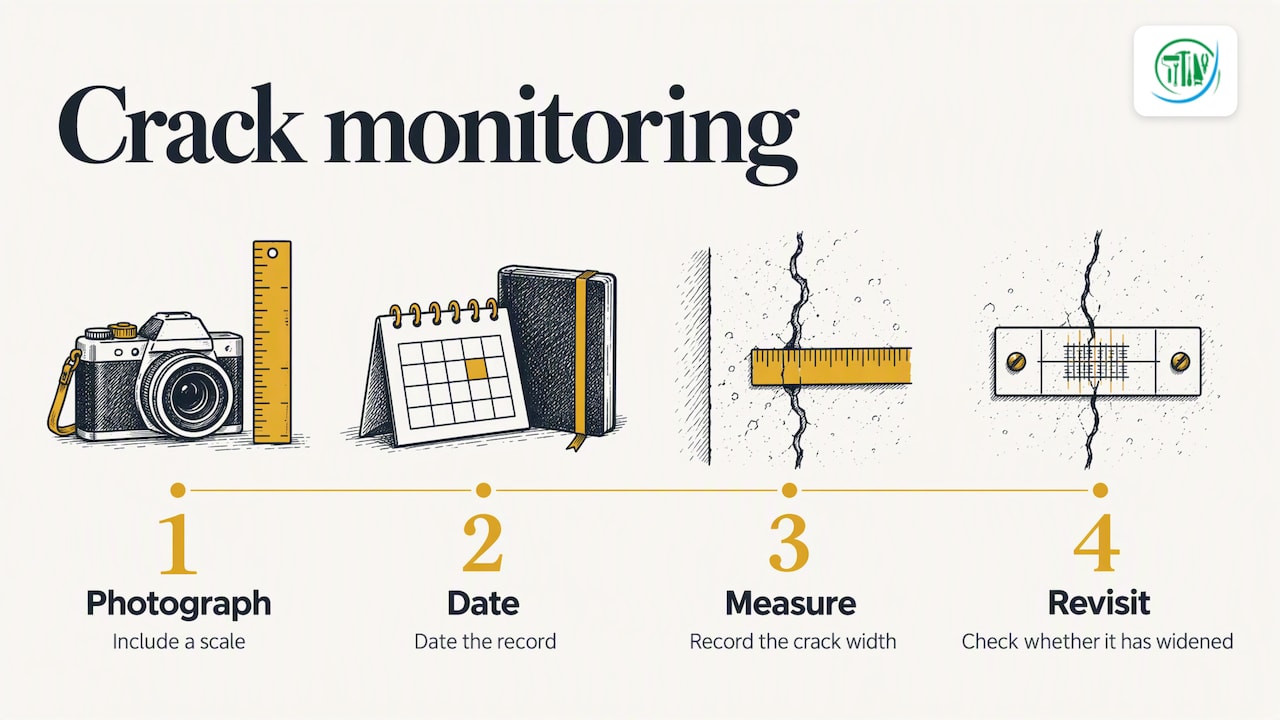
For active-or-not questions, the evidence is a record. Photograph the crack with a scale in shot, date it, measure its width and revisit it. A crack that has not changed across several visits tells a very different story from one that has opened. If movement is suspected, a wider look at the building is justified, and a commercial building condition survey is the sort of document that puts the defect in context.
Impact and everyday damage
Trolleys, furniture moves, door handles, ladders and fit-out work account for a large share of wall damage in common parts and offices. Plasterboard dents and punctures, chipped corners and scuffed lobbies are mostly cosmetic, but a hole through a fire-rated wall or ceiling is not, as covered below. Impact damage also tends to be repeated in the same places, which is a cue for protection: corner guards, kick plates and door stops are cheaper than repeated patching.
Ceiling damage from above is a separate case. Service installers lifting tiles, cutting access holes and pulling cables leave broken tiles, bent grid and unsealed penetrations. These are often the first thing that goes wrong when several trades work in the same void without coordination.
Failed plaster and finishes
Plaster can fail without any dramatic cause. It can lose its bond to the background, sound hollow when tapped, crack in a map pattern, or blow off in patches. Causes include a poor bond to the substrate, a mix applied too thick, earlier damp that has since dried, or old paint layers that have lost adhesion. A hollow-sounding patch is usually a sign that the plaster needs removing back to a sound edge rather than skimming over, since a skim coat bonds only as well as the layer beneath it.
Check before you cut: asbestos in ceilings and walls
If your building was built or refurbished before asbestos was banned, a ceiling or wall repair can disturb asbestos-containing materials. Textured coatings, ceiling tiles, boards and sprayed finishes are the kinds of materials that turn up in ceilings and walls. The point of the register is that nobody has to guess.
The duty and who holds it
Under the Control of Asbestos Regulations, the person with the duty to manage asbestos in non-domestic premises has to assess whether asbestos-containing materials are present, how much, where they are and what condition they are in. The HSE guidance on the duty to manage asbestos sets out the obligations in full. For your purposes, three points matter when a repair is planned:
- Consult the register before the work starts. Not after the first hole has been drilled.
- Share it with the contractor. The people doing the work need to see what the register says about the exact area, not a general statement that the building is fine.
- Presume, if you do not know. Where the status of a material is unknown, it should be presumed to contain asbestos until it is shown not to.
Who is the duty holder? HSE says it can include the building owner, the landlord, or the person or organisation with clear responsibility for maintenance. In a multi-let building or a block managed by an agent, that responsibility may be written into the lease or the management agreement, so confirm who holds it rather than assuming. HSE also keeps an overview of the duty to manage, which is a useful reference for a new site handover.
What to do when the register is silent
The common awkward case is a register that does not cover the area, or a building where no register can be found. Treat that as an unknown, not as a clear. Stop, do not disturb the material, and arrange for the status to be established by a suitably qualified asbestos professional before cutting, drilling or sanding starts. That is outside the scope of what we do: we do not carry out asbestos surveys, sampling or removal, and we would not suggest any contractor proceed on a guess.
HSE also distinguishes licensed work from non-licensed work. The reference page describes non-licensed work as sporadic, low-intensity work that does not exceed 0.1 asbestos fibres per cubic centimetre of air, averaged over four hours. That is a threshold for the assessor to apply, not a judgement a ceiling contractor should make on the day. If the work looks likely to disturb asbestos, it needs to be assessed and, where required, carried out by the right people before anything else happens.
A pre-work checklist
- Is there a current asbestos register, and does it cover this room, void or riser?
- Has the extract for the work area gone to the contractor in writing before they attend?
- Does the register say anything about the ceiling tiles, boards, coatings or pipe lagging in the area?
- If the area is not covered, has the work been paused until the status is known?
- Has someone told occupiers where the work is and that no one should disturb the area?
- Is there a permit to work in place for the job? Our guide to the permit to work system in building maintenance explains how that sign-off controls access, isolation and the information the operative has seen.
Repair methods by surface
The right repair depends on what the surface is made of and how far the damage goes. These are the common cases in commercial buildings.
Plaster walls and ceilings
For stable, fine cracks, the usual approach is to rake out the crack, fill it, reinforce it where appropriate and redecorate. For blown or hollow plaster, the sound edge has to be found first, so loose material is cut back and the background is prepared before patching.
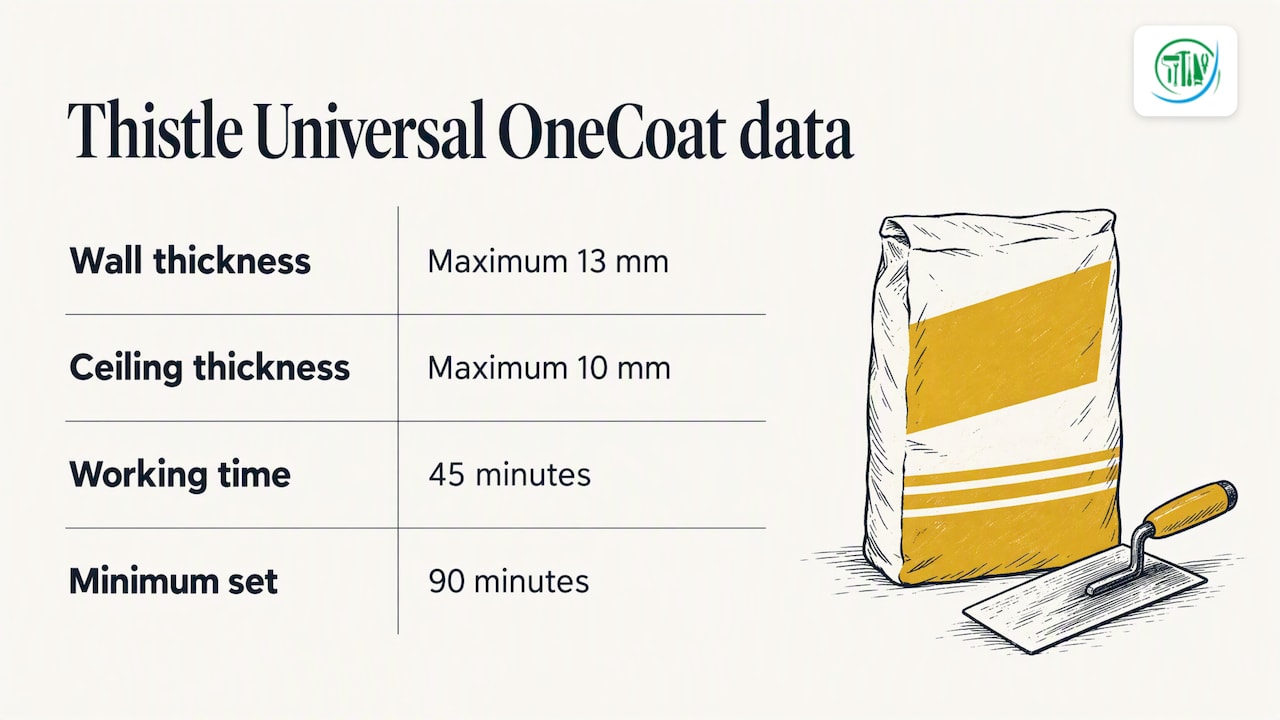
The product data matters. British Gypsum’s data sheet for Thistle Universal OneCoat gives a maximum thickness of 13mm on walls and 10mm on ceilings, with a 45-minute working time and a 90-minute minimum set time. Those figures are for that product only, but they show why deep patches are built up in stages rather than filled in one go. Always work to the manufacturer’s data sheet for the product being used.
Where the plaster is historic, the approach changes. Re-anchoring a loose area with screws or resin may be better than stripping it, and fibrous plaster in particular needs people with the right skills. Historic England’s guidance on the care and management of historic fibrous plaster explains the construction, a plaster of Paris casting reinforced with hessian and fixed to timber, and why it should not be treated like modern board.
Plasterboard
Plasterboard repairs run from a simple fill to a full panel replacement. British Gypsum’s guidance, as summarised in our research, is that minor dents where the core is intact can be filled, whereas a shattered core, or damage to fire-resistant board, calls for a repair or replacement specific to the fire rating of the system. The practical rule:
| Damage | Typical approach |
|---|---|
| Shallow dent, core intact | Fill, sand and redecorate |
| Small hole, standard board | Patch or cut-out repair, taped and finished |
| Shattered or crumbled core | Cut back to the framing and replace the section |
| Water-damaged board | Fix the leak, dry the area, replace affected board |
| Fire-resistant board or compartment wall | Repair to the specification of the system, not a general patch |
Water-damaged board is the case where speed counts. Boards that have stayed wet can lose strength, and the cavity behind needs to be dry before it is closed. Replacing the board while the source still leaks simply restarts the clock.
Suspended ceilings
Suspended ceilings are the simplest to repair, and also the easiest to damage further. Stained, cracked or sagging tiles can often be replaced individually, but check three things first:
- Match. Tiles come in different sizes, edges, finishes and performance ratings. A like-for-like swap keeps the acoustic and fire performance the ceiling was designed with.
- The grid. Bent or corroded sections, loose hangers and missing clips need correcting, otherwise new tiles sag.
- The void. A stained tile is a pointer to what is above it. Look for leaks, condensation or failed insulation before fitting a new one.
With a tile removed you can see cabling, pipework and any asbestos-containing material in the void. That is a reason to check the register before lifting tiles, not after. Suspended ceilings are also where uncoordinated trades leave unsealed holes.
Fire safety: why patching is not always enough
When a wall or ceiling forms part of a fire compartment, the repair has to restore the fire resistance of the whole element. That includes gaps around pipes and cables, which need fire-stopping materials appropriate to the rating of the wall or floor they pass through. A fire strategy document published on gov.uk makes the same point about fire-resisting walls and their protection; it is an early-stage draft for a specific project, so use it as an illustration of the principle, not as your specification.
In practice that means asking the contractor whether the wall or ceiling is fire-rated, what the rating is, and how the repair will keep it. If the fire strategy or fire risk assessment for your building identifies compartmentation, the answer should be in there. Fire safety responsibilities for most non-domestic buildings sit under the Regulatory Reform (Fire Safety) Order 2005, and the responsible person should be told when compartment elements are opened up.
Building regulations also reach further than many agents expect. Routine minor repairs are often exempt, but structural alterations, fire-stopping works and extensive replacements may need notifying to Building Control, and an installer who is not registered with a competent person scheme can leave you without the certificates you need later. The government’s page on building work, replacements and repairs is written for homes, so confirm the position for your own building with Building Control before major works.
Working at height on ceilings
Ceiling work is work at height, and the Work at Height Regulations 2005 apply. HSE explains that the Regulations cover all work at height where a fall could cause injury, and that they place duties on those who control the work of others, which includes facilities managers.
The common misconception is that ladders are banned. They are not. HSE’s work at height FAQs are clear that the work must be planned and organised, those doing it must be competent, and the risks must be assessed and suitable equipment chosen. A stepladder can be right for a short, low-risk task, but a heavy or prolonged job such as boarding out a large ceiling calls for a tower or a mobile elevating work platform. HSE also publishes a page on common work at height myths, including one about stepladder use, worth reading before you write method statement requirements.
Ask the contractor which equipment they plan to use and why. That one question tells you a lot about how the job has been thought through.
Our perspective: one team, one record
The pattern we see in ceiling and wall defects is that the repair itself is rarely the hard part. The hard part is the chain around it: the leak that started in one trade’s area, the register held by someone else, the plasterer who needs the electrician to isolate a circuit and the decorator who comes in last. When each step is a different vendor, information gets lost, and the ceiling gets patched over the cause.
We deliver planned and reactive maintenance for London commercial properties under a single contract, covering plumbing, electrical, carpentry, roofing, painting and decorating, bricklaying, voids and communal areas. For a ceiling defect that means the person who finds the stain can bring in the plumber or roofer who fixes the cause and the trade who makes good, with one contract manager accountable for the sequence. Operatives are DBS checked, and we hold SafeContractor and CHAS accreditations.
Our advice to managing agents is simple. Ask for the cause, not just the quote. Hand over the asbestos register extract before anyone attends. Keep dated photographs. And treat a recurring stain in the same spot as a maintenance finding, not a decorating job.
— BW Building Maintenance
How we help with ceiling and wall defects
If your portfolio has recurring ceiling stains, damaged communal walls or void units that need making good, our planned and reactive building maintenance covers the trades involved under one contract, with monthly reporting and a named contract manager for your portfolio. Compliance-related remedial works and void refurbishment sit within the same arrangement.
Frequently asked questions
Can you skim over blown plaster?
Generally not. Skim coat bonds only as well as the plaster beneath it, so loose or hollow areas should be cut back to a sound edge and patched first. On historic plaster, ask for an assessment before removal, because some de-bonded areas can be re-anchored instead.
When should a crack in a ceiling or wall worry me?
Be concerned when it is wider than about 3 to 5mm, runs continuously through the wall or ceiling, follows mortar lines diagonally or is growing. Cracks near door frames, lintels or extension joints also deserve a professional look. Council guidance for residential blocks uses these signs, and dated photographs help show whether movement is active.
Do I need to check the asbestos register for a small repair?
Yes. Before any drilling, cutting or repair to building fabric in non-domestic premises, the register should be consulted and shared with the contractor. If the status of the material is unknown, presume it contains asbestos until shown otherwise.
How do I repair a ceiling that has water damage?
Find and fix the source first, then let the area dry. After that, damaged plasterboard or tiles are replaced and the surface made good. In older buildings with traditional or fibrous plaster, get an expert view before stripping, since not all wet plaster needs replacing.
Sources
- HSE guidance on the duty to manage asbestos
- HSE: the duty to manage asbestos, overview
- HSE: check if you have the duty to manage asbestos
- HSE: work at height, construction FAQs
- HSE: work at height, frequently asked questions
- HSE: common work at height myths
- Historic England: inspection and maintenance of fibrous plaster ceilings
- Historic England: historic fibrous plaster, care and management
- Welwyn Hatfield Borough Council: cracks and structural damage
- British Gypsum: Thistle Universal OneCoat product data sheet
- GOV.UK: fire strategy draft
- GOV.UK: building work, replacements and repairs